Fundraising Process for Pre-Revenue Startups
Investors now demand structured proof of traction instead of revenue from early-stage founders.
The fundraising playbook from 2021 no longer works, and founders who still run it will lose rounds to people who understand what changed. The fundraising environment has reset structurally, and pre-revenue founders who fundraise the way founders did in 2021 will fail in 2026.
The rising evidence bar for pre-revenue startups heading into 2026
In 2021, a founder with modest SaaS revenue and a growth story could close a large Series A on the strength of momentum alone. That era is over, and investor expectations now run roughly twice as hard to clear as they did four years ago. What used to pass for seed-stage conviction now barely qualifies: the seed environment in 2026 looks like Series A did a few years back, with investors wanting real ARR and unit economics that hold up under scrutiny. The bar hasn't just gone up. It has moved forward an entire stage, so founders raising seed rounds are now expected to clear hurdles that used to belong to the next round up.
Layered on top of that shift is a second filter that has nothing to do with stage and everything to do with category. AI companies took in roughly half of all pre-seed dollars in the first half of 2026, which leaves non-AI founders fighting over a shrinking share of an already concentrated pool. Some founders read these two forces together and conclude that pre-revenue companies have simply become unfundable, but the cold-start round is dying: two of three Series A deals involve a founder known to the investor for six to nine or more months prior, with relationship infrastructure, not pitch decks, as the primary conversion mechanism. That conclusion is wrong. What has changed is not whether pre-revenue founders can raise, but what they need to show in order to do it. Revenue is no longer the default proof of demand that investors lean on, and in its place a hierarchy of structured evidence has taken over as the thing investors actually read.
What "structured proof" means at the pre-revenue stage
Pre-revenue means the evidence takes a different shape, and that shape has a rough order of weight that experienced investors have learned to read quickly. Customer discovery interviews sit at the bottom of that order, useful but thin on their own. Waiting lists carry more weight when they come with context about who signed up and why. Letters of intent carry more still, because they represent a stated commitment rather than curiosity. Design partnerships and paid pilots in flight sit higher yet, since they involve a counterparty putting resources behind the relationship. Alpha users sit near the top, because they represent people actually using the product under real conditions.
None of this is revenue, and that distinction means a founder can show strong traction signals while still having zero dollars of recognized revenue to point to. A founder can walk into a pitch meeting with signed LOIs, a live alpha cohort, paid pilots already running, and a waitlist numbering in the thousands, and still report zero dollars of recognized revenue on the books. What separates a founder who closes from one who doesn't is rarely the raw size of these numbers. It's whether the founder presents them honestly. The same number dressed up to sound like something larger reads as the opposite, and investors who sit through pitches for a living notice the difference quickly.
Four assumptions keep founders from building this kind of proof in the first place, and all four are false: that pre-revenue means no traction, that it means no product, that it means an inability to raise funds, and that it means no defensible valuation. On that last point, the absence of revenue does not leave founders without a number to work with. Investors have several established methods for valuing a pre-revenue company, including the Berkus method, Risk-Factor Summation, the Scorecard method, the VC method, and approaches like Cost-to-Duplicate and Comparable Transactions. A founder walking into a negotiation without revenue still has a legitimate basis for a valuation conversation, provided the underlying evidence is there to support it.
How the funding stage shapes evidence and capital sources
Not every pre-revenue round is competing in the same arena, and founders who treat pre-seed, seed, and the bridges between them as one undifferentiated category tend to pitch the wrong evidence to the wrong audience. The stage a founder sits at determines what counts as sufficient proof, which sources of capital are realistically available, and what the money costs in time and dilution.
At pre-seed, median valuation caps heading into 2026 are in the low-to-mid eight figures, with smaller rounds commanding lower caps than those crossing the seven-figure mark. The dominant instrument at this stage is the post-money SAFE with a valuation cap and no discount: the large majority of SAFEs now issued carry a post-money cap, and discounts have fallen sharply from where they used to sit. A common sequence among founders who close is to raise a small angel round first on a SAFE, use that money to hit a specific milestone such as a working demo or a first paying customer, and then open a larger and more formal pre-seed round once that milestone is in hand.
Seed has institutionalized in a way that changes what a founder needs walking in. Median post-money valuations at seed have climbed into the mid-eight figures heading into 2026, and investors at this stage now expect more than a working prototype: early traction signals, and increasingly first revenue itself, have become the norm rather than the exception. The sector a founder operates in changes the specifics of that expectation. AI and ML infrastructure companies carry different median round sizes and valuation ranges than SaaS companies, so the question of what to ask for has to be calibrated against the sector a founder is actually competing in, not a generic benchmark.
Timing has stretched out as well. The median gap between seed and Series A now runs 616 days, close to 20 months. Founders who build 24-month runway per round out-raise peers chasing the old 18-month cycle.
Where the money comes from matters as much as how much of it there is. Angels move quickly and write smaller checks. Pre-seed VCs move more slowly but write larger ones. Accelerators compress the learning curve for first-time founders and make subsequent rounds easier to close. Grants carry no dilution at all but come with slow timelines and narrow eligibility criteria. The right choice depends on fit between the founder's stage and need, not simply on which source offers the largest check.
The structural change in investor behavior that makes targeting precision non-negotiable
Beyond the question of evidence, the way investors find and evaluate founders has changed in a way that punishes broad, undifferentiated outreach. The cold-start round, where a founder pitches a stranger and closes on the strength of the deck alone, is dying. Two out of three Series A deals now involve a founder the lead investor has known for six to nine months or longer before the round closes. Relationship infrastructure built well before the raise, not the pitch deck itself, is doing the real work of conversion.
Compounding this is the fact that multistage firms have moved downstream into territory that used to belong to seed-only funds. Andreessen Horowitz alone has made more than 300 seed and Series A investments since the start of 2024, as of November 2025, and more large firms are expected to follow that pattern. That shift changes how early rounds get priced and what it signals when a particular investor leads a round, which matters directly to a pre-revenue founder competing against a startup that already has a multistage firm's name attached to its cap table. A founder in that position needs to know precisely which investors are still writing checks at their specific stage, sector, and level of evidence. A broad, scattershot list burns through the one resource a pre-revenue founder cannot recover once spent, which is time.
The data that would make this targeting easy has historically lived behind a paywall few early-stage founders could justify. Platforms like PitchBook offer deep private capital market data, but the cost puts them out of reach for most pre-revenue companies, and that gap between what institutional investors can see and what founders can afford is a real structural disadvantage. AI-native tools built specifically for founders are starting to close that gap, giving smaller teams a version of the research capability that used to require either an expensive subscription or a large existing network. Warm introductions still convert at a far higher rate than cold outreach, and the founders who benefit most from these tools are the ones who start building relationships weeks before a raise opens, not the moment the bank account runs low.
Building the investor pipeline as an operational system, not an improvised list
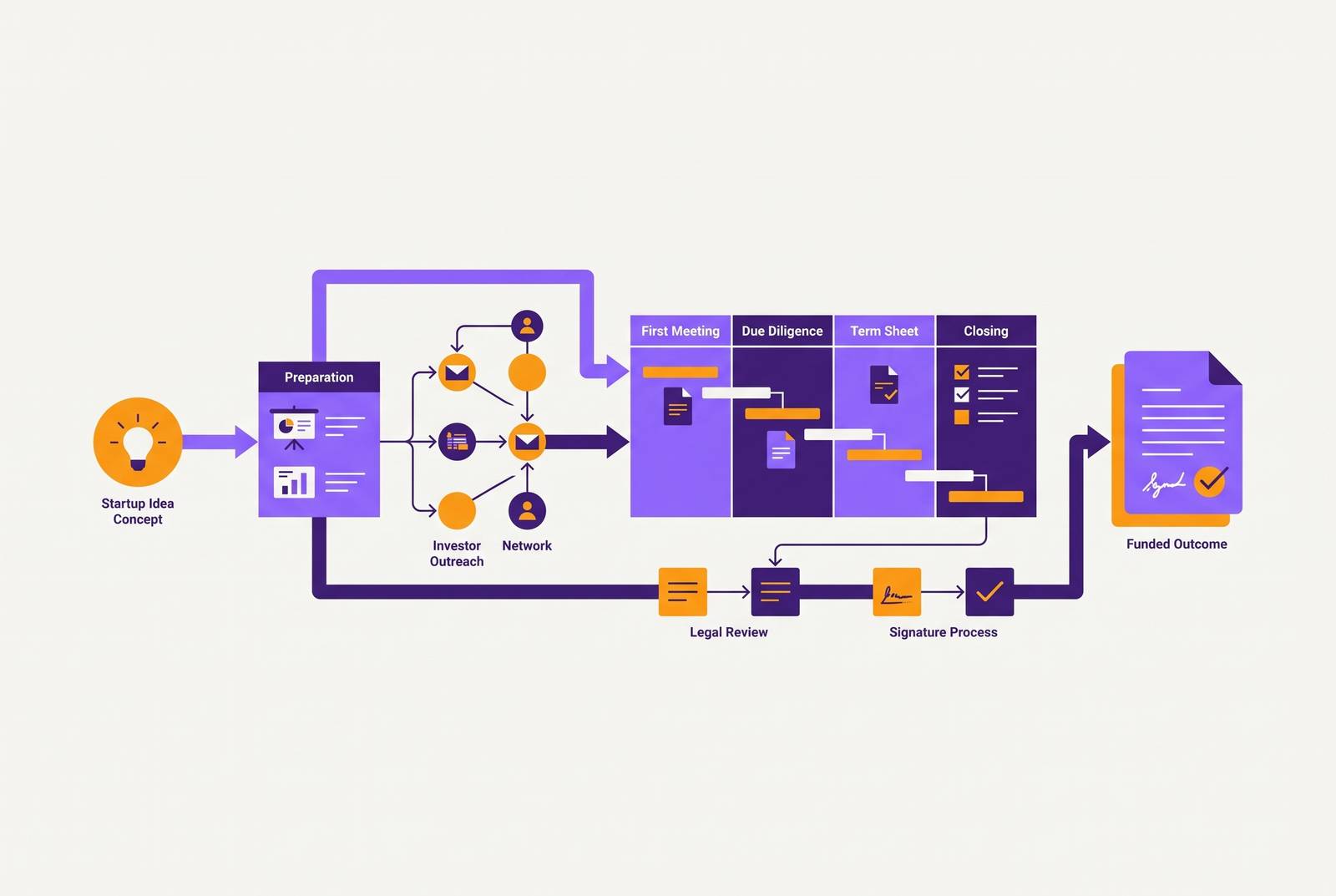
A list of investor names in a spreadsheet is not a pipeline. The founders who actually close rounds manage their investor pipeline the way a sales team manages a CRM, with defined stages, clear ownership of each relationship, specific next actions, and a steady cadence of follow-up.
That pipeline needs to exist before the raise opens, not after. Building it starts with identifying target investors by sector fit, typical check size, and stage focus, then mapping out warm introduction paths through whatever network already exists, and finally tiering those targets by how likely they are to say yes and how quickly they tend to move. The weeks before a raise should be spent having relationship-building conversations: asking for feedback on the idea, sharing early signals of progress, and establishing a track record so that the eventual pitch lands as one more data point on a trajectory the investor has already been watching.
A set of AI-native fundraising tools has matured enough to support this kind of system, and the leading ones tend to specialize by function. Finta works as a relationship-driven fundraising workspace, combining CRM functions with connected context on investors, research, mapping of warm paths, pitch sharing, and tools for following through after initial contact. Visible brings together investor discovery, a fundraising CRM, pitch sharing, data rooms, and investor updates in one place. An investor database alongside CRM functionality, outreach tools, update tracking, deck hosting, and a data room can be built into a toolkit that has been around long enough to mature. OpenVC covers investor discovery, outreach, a fundraising CRM, pitch deck tracking, and investor updates in a single platform.
For the narrower task of investor matching, some tools analyze a company's profile against sector, stage, and portfolio fit to surface relevant investors, cutting down a research task that used to demand either a large personal network or an expensive data subscription, while Harmonic takes a related approach from the investor side, using machine learning to help VCs and investors spot relevant startups by reading signals like hiring activity, funding history, and growth data.
Whatever tool sits underneath it, the pipeline only works if it's kept current. Every investor in it needs a clear stage, whether that's contacted, meeting scheduled, met, passed, or pending, along with a specific next action and a deadline attached to it. A pipeline with names in it but no next actions attached is effectively dead weight. When an investor passes, the question worth asking them directly is whether the issue was stage fit, sector fit, perceived risk, or the strength of the evidence presented. That answer feeds directly into how the next conversation gets pitched, and sometimes reshapes how the rest of the round gets run.
Building a pitch narrative without revenue
A pre-revenue pitch lives or dies on the order in which its argument unfolds, not on whether a revenue line appears anywhere in the deck. Investors are backing the founder who tells the sharpest, most specific story about a real problem they are unusually well positioned to solve. No amount of visual polish fixes a pitch where the underlying sequence of logic is weak. A clean, well-designed deck can support a strong narrative, but it cannot substitute for one.
The format that tends to work follows a consistent pattern: a concise deck, heavy weight placed on the team slide, and a sharp, specific account of why this founder and this market fit together. The team slide carries more weight here than it would in a later-stage pitch precisely because there's no revenue line to lean on instead. The strongest narrative architecture leads with the problem and the insight behind it, then lets traction signals, market size, and the strength of the team reinforce a single central claim. That claim has to carry the full weight of the pitch, because polished financial projections alone were never going to hold up at this stage regardless of how carefully they were modeled.
Early evidence needs to appear in the deck exactly as it is, without dressing it up to look bigger than it was. Design partners, pilots, letters of intent, a waitlist with real context behind it, each one should be labeled for what it is. A small number of design partners, stated honestly, reads as a founder with a clear grasp of their own business. The same evidence inflated to sound more impressive reads the opposite way to an investor who has sat through hundreds of these pitches and knows what padding looks like.
On the practical side, the founders who do this well tend to build two versions of the deck that differ in density but never in the underlying substance: a reading deck meant to be sent and absorbed on a screen, and a presenting deck meant to be talked through live. The reading deck should come first, because writing it forces the full argument onto the page in complete form, and only after that argument is settled does it make sense to strip the deck down for live presentation.
In the six to nine months before a raise, founders should be having at least three to five substantive customer discovery conversations with named potential customers, since this is the underlying work that generates the evidence in the first place. That is the minimum credible proof of demand available to a founder with no revenue line to point to, and it is what ultimately gives the narrative something real to stand on.