First Close vs. Final Close Strategy in Seed Rounds
A first close creates momentum, but only if you set a final close date before the raise drifts.
A seed round in 2026 gets decided twice: once when the first dollar commits, and once when the founder decides no more dollars are welcome. Between those two moments sits a strategic choice that now carries more weight than it did even three years ago, because the market has gotten narrower, pricier, and far less forgiving of a raise that drags. This piece lays out what a first close and a final close actually do, why confusing them is the single most common way a seed round goes sideways, and what a disciplined process looks like from the first outreach email to the signed term sheet.
The Seed Market in 2026 and Round Structure as Strategic Decision
The number of U.S. seed rounds has fallen well off its 2021 peak, even as the median round size has grown, which tells a specific story: capital is not spreading across more companies, it's concentrating in fewer of them. A founder competing for a shrinking pool of lead checks does not have the luxury of a sloppy process, because the investors on the other side of the table have more companies to choose from and less patience for a round that wanders.
The math past the seed stage makes the stakes concrete. Only about 30 to 35 percent of companies that close a seed round go on to raise a Series A, down from roughly half during the 2018 to 2021 cycle. That decline means the seed round has stopped functioning as a stepping stone on an assumed path and become a single, high-stakes attempt to clear a bar that keeps rising. Headline valuations are also getting pulled upward by AI-native companies commanding a premium that does not exist for most other founders, so the "median seed" figure quoted in any report is really an average of two different markets layered on top of each other.
None of this is abstract once a founder is actually running a raise. A round that drags, stacks incompatible instruments, or closes without a clear endpoint does not just cost time: it erodes the cap table and the runway that keep the company alive when Series A conversations begin. Round structure, in other words, has become one of the few variables a founder can actually control in a market that has otherwise tightened against them.
What a First Close and a Final Close Are
A first close is the moment a round acquires social proof and turns into a moving target that other investors now have to react to. A final close is a different kind of event entirely: it's the date on which the founder stops raising and returns to building the company. Conflating these two moments, treating the first close as a milestone to coast on rather than a lever to pull, is what causes rounds to drift without ever quite finishing.
The two closes call for opposite instincts. After the first close, the job shifts to holding terms, filling the remaining allocation quickly, and resisting the pull to leave the round open "just a little longer" in case a better offer appears. Rolling closes, where tranches open and close at the same or rising valuation caps, sit between these two poles. They can manage momentum effectively, but only if the founder has already set a final-close date before the rolling structure begins. Without that date, a rolling close is just a first close that never graduates into a final one.
This distinction is the structural backbone of a well-run raise. In a bifurcated market where capital is concentrating in fewer companies, the founders who separate top-decile outcomes from the median are usually the ones running the raise with that kind of operational precision, knowing who their target investors actually are, what terms are realistic for their sector, and how their pipeline compares to what similar companies are closing.
How the first close creates momentum
The first close works because investors respond to other investors, not to pitches in isolation. A partially filled round changes the math for everyone looking at it: if credible people have already committed, the cost of waiting goes up and the cost of saying yes goes down. That dynamic does not happen by accident. It has to be built.
Sequencing is the first lever. The first close, in this sense, gets built in layers rather than won in a single meeting. Batching outreach matters just as much as sequencing it. Contacting top targets within the same two-week window creates real urgency, because staggered outreach lets investors wait each other out, which is the exact opposite of the momentum a founder needs. Timing against the calendar compounds both effects: January and September are the natural entry points for a raise, and launching into a holiday gap or a quarter-end review period means the pitch lands on a distracted audience before anyone has a chance to hear it properly.
A January to March 2025 survey of 12 seed closes shows how far these mechanics can stretch the outcome. Tom, raising with two prior exits behind him, entered climate tech, a sector with strong investor appetite in that quarter, with a pitch that had already been pressure-tested before outreach began. His first close came in six weeks because the conditions for it were already in place before the first email went out. Maya's raise ran the opposite way. Ninety days later she was rebuilding the list from scratch with no term sheets to show for it, because the first-close conditions, sequencing, batching, timing, were never established in the first place.
Sequencing outreach this way is not just a matter of discipline, it depends on knowing something about each investor before the first email goes out: their recent deals, typical check sizes, and stated thesis, along with a reasonable sense of how quickly they tend to decide. That kind of investor-level intelligence turns a first close from a hopeful bet into something closer to a predictable outcome.
Risks of a First Close at the Wrong Price or With the Wrong Investors
Speed to a first close is not the only variable that matters. A first close that happens too cheaply, or with investors who carry no real signal weight, can do more damage to a raise than a slower one built on firmer footing. The momentum lever described above only works if the first movers are actually credible to the investors who come next.
Price is the clearest failure point. A capped SAFE prices a company whether or not the founder is willing to call it a valuation, and a generous cap handed out to a friendly angel at the pre-seed stage becomes the number a seed lead anchors to later, whether or not that number reflects the company's actual position. With priced rounds now representing roughly half of all seed deals in 2026, investors increasingly expect clean ownership structure from the start, and a cap table built from several stacked pre-seed SAFEs at different prices can make a seed lead reluctant to price the round at all. There's a real counterargument here, though. Valuations across the current market are more rational and more tightly clustered than they were in 2021, and founders who accept realistic pricing early often arrive at Series A with cleaner cap tables and stronger negotiating positions than peers who chased the last available frothy term sheet.
What resolves the tension is recognizing what the first close is actually for. The goal was never just capital committed, it's signal transmitted, and who commits first matters as much as how much they commit. A first close anchored by a recognized seed fund carries more weight in 2026 than it would have during a period when capital was abundant and nearly everyone was writing checks. The quality of the first close, not just its speed, shapes whether the momentum that follows is real or only apparent.
What the Final Close Tests
Once the first close is secured, the most common failure mode is an open round with no declared end date, which gives investors tacit permission to keep waiting and can turn what should be a six-week raise into a nine-month slog. The urgency the first close worked so hard to create simply dissolves as the weeks pass without a deadline forcing anyone's hand.
Founders who leave a round open after the first close often describe this as patience. The data on timelines backs this up directly: a seed round typically runs three to six months from first meeting to close, and the same 12-close survey found a median timeline of 4.5 months, with the fastest close landing at six weeks. The final close tests terms discipline as much as timeline discipline: founders who keep a round open past its natural window often find later investors asking for better terms than the first close established, because an extended timeline reads correctly as a sign of soft demand.
YC partners have advised founders directly against fundraising simply because the calendar allows it, and veteran founders echo the same instinct in blunter terms: don't fundraise forever, get back to work as fast as possible. That matters because the 65 to 70 percent of seed-funded companies that never reach Series A are not all failed businesses in the ordinary sense. Many of them ran out of runway that was burned by an extended, undisciplined raise, one that delayed real product work and hiring by months while the founder kept chasing one more conversation.
Tracking exactly where that discipline breaks down, who has responded, who needs a nudge, and when the round should formally cap, requires actually managing the pipeline rather than carrying it in a founder's memory or a scattered spreadsheet.
Round Instrument Choice and the Discipline of Both Closes
The decision between a SAFE and a priced round is a structural choice about how much pressure the instrument itself puts on the founder and the investor to actually reach a decision. SAFEs make rolling closes easy, no new paperwork per investor, no board seat negotiation to slow things down, but that same ease is the source of drift. A SAFE with no stated cap can stay open indefinitely, because the instrument supplies no structural forcing function that pushes the round toward a close.
Priced rounds work differently. The cap table locks at signing, the board seat triggers real governance rights, and the lead investor has a direct incentive to fill the round quickly in order to protect their own ownership position, which builds a natural endpoint into the process itself. For smaller raises, SAFEs remain the dominant and appropriate instrument, but the founder has to supply the discipline the instrument itself doesn't provide: a stated cap, a stated closing date, and a real commitment not to extend the round without a clear reason. Founders should expect somewhere between 25 and 40 percent or more in cumulative dilution by the time those stacked SAFEs convert, once an option pool refresh is factored in.
The practical read for 2026 is to plan, wherever possible, for a single priced round sized to 18 months of runway at the new, higher Series A bar. That structure avoids stacking multiple instruments, forces a clean and final close, and hands the eventual Series A lead a cap table simple enough to actually price against. Instrument choice, in the end, is an expression of the first-close and final-close discipline described above: the instrument either reinforces the forcing function a founder needs or quietly removes it.
Running the process so the first close and final close are planned events, not accidents
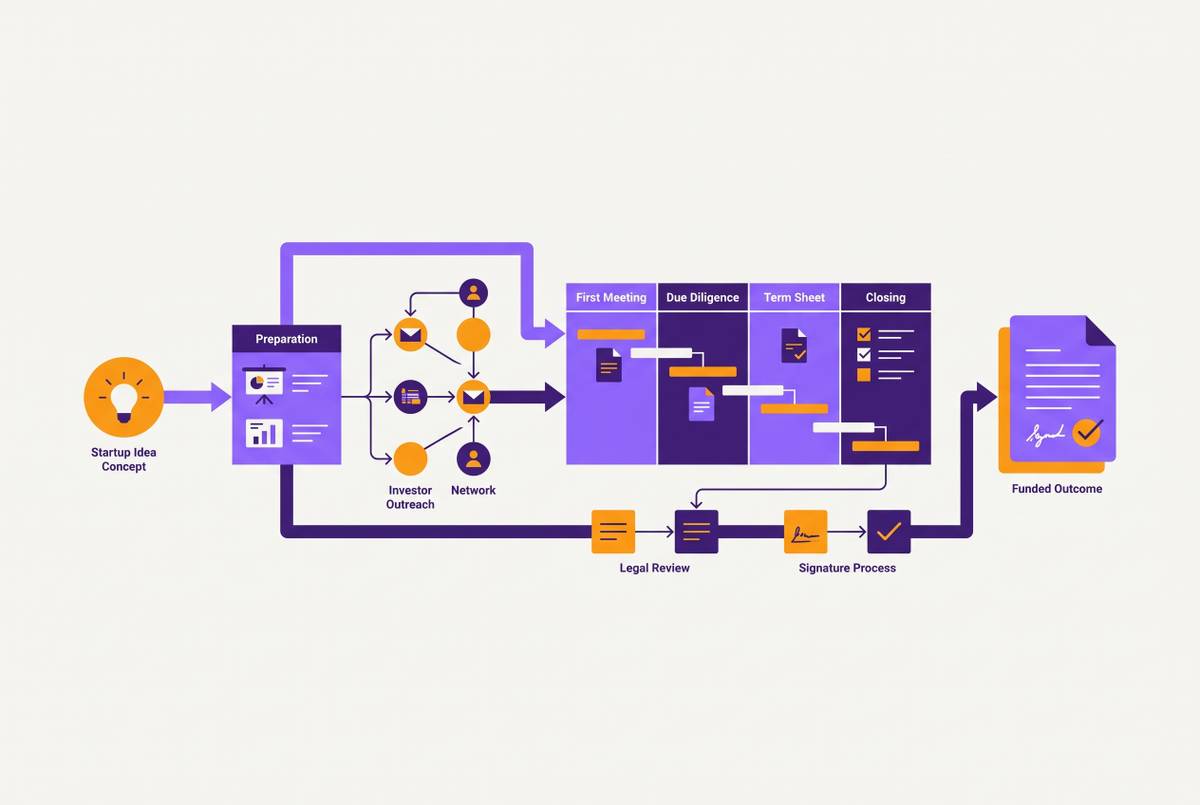
A raise that produces a strong first close and a disciplined final close is fast because each stage was treated as a distinct task with its own deliverable, planned before outreach ever began rather than improvised once meetings started. Most founders underestimate that target by 20 to 30 percent, an error that forces a mid-raise extension later and signals weakness to exactly the investors a founder most needs to impress.
The investor list itself needs the same tiered structure described earlier in the raise, built out fully before outreach starts rather than assembled on the fly. Tier 1 covers the lead-caliber seed funds with a demonstrated thesis fit for the company, and those conversations get saved for after the pitch has been sharpened and early momentum already exists. Tier 2 and Tier 3 cover sector-adjacent angels, syndicates, and smaller funds, and outreach starts there, generating the first yeses and refining the pitch before it ever reaches the investors whose names carry the most signal weight. A smaller, well-matched list built on real research into each investor's recent deals, typical check size, and stated thesis consistently beats a much larger cold list sent out in a single undifferentiated blast, which is exactly the mistake that stalled Maya's raise for three months with nothing to show for it.
What ties all of this together is a single operating principle: the first close and the final close are not two halves of the same lucky break. They are two different disciplines, built from two different sets of decisions, made well before either moment actually arrives.