How to Read an Investor Thesis Before You Write the First Email
Decode a VC's actual investment priorities by studying their portfolio, not their website.

A published VC thesis tells a founder almost nothing about whether that fund will write the check. The real thesis, the one that actually governs a partner's decision, lives somewhere else entirely: in the deals the fund has closed in the last eighteen months, in the essays a partner posts at 11pm, in the pattern of what got funded versus what got politely declined. Founders who learn to read that operational thesis before sending a single email convert cold outreach into something closer to a qualification process, and they avoid the single biggest cause of fundraising failure along the way.
What a thesis contains and how its components can be read against each other
Per VC Lab's guidance, a fund's actual investment thesis is private, meant for Limited Partners only. What founders find on a website or in a pitch deck is a different document entirely, built for a different audience with a different job to do. It usually reads something like: "[Fund Name] is raising a $50MM early-stage fund in the Bay Area to back enterprise AI companies, leveraging deep operator networks." That sentence exists to help a fund raise capital from LPs. It was never designed to describe what actually happens when a partner reviews a deck on a Tuesday afternoon.
Per waveup.com's breakdown, a full thesis document, whether written for LPs or as an internal memo, tends to carry five components: sector and sub-sector focus, a stage range with a preferred entry point, a check size band, geographic scope, and thematic conviction, something like "AI-native infrastructure" or "climate" or "longevity." There's often a sixth, quieter component too: portfolio gap criteria, meaning what the fund still doesn't have and is actively hunting for. That last one rarely makes it onto a website, and it's often the most decision-relevant piece of the whole document.
A framework from a business publication, cited in that same waveup.com piece, argues the strongest thesis statements combine three things: a market tailwind, a structural moat hypothesis, and a portfolio-fit rationale. Founders who internalize that structure stop reading a thesis as a label and start reading it as an argument, one with a logical gap somewhere that their company might fill.
It also helps to know there isn't just one thesis document in circulation. Per waveup.com, founders will run into four distinct types: the fund thesis (one to three pages, written for LPs), the portfolio thesis (an internal one to two page memo justifying a specific deal), the thematic thesis (public sector-level writing, the kind a16z publishes on crypto or USV runs on its thesis blog), and the founder's own thesis, the one-page case for why this market, this product, this team, right now. Confusing these documents for each other is a common mistake; a thematic essay is not a commitment, and a portfolio memo is not a public statement of intent.
There's a useful data point buried in VC Lab's 2026 research on how funds present themselves to LPs: when ranking the credibility signals investors lean on most, exits and investment performance sit at the top, while years of experience ranks last. That hierarchy matters for founders too, because it tells you what a fund cares about proving. A fund heavy on "years of experience" language and light on exits is often still building its track record, which changes what kind of company it needs next.
The pattern to hold onto: the parts of a thesis that take five minutes to find, sector and geography, are the least predictive of whether a check gets written. The parts that take real digging, sub-sector conviction, recent portfolio gaps, a specific partner's stage preference, are the parts that actually decide fit.
Reading portfolio behavior as the primary thesis signal
A fund's portfolio is its thesis with all the marketing stripped out. What a firm says it backs and what it has actually put capital behind over the last two years are often two different stories, and the gap between them is where thesis drift hides.
Cross-referencing stated focus against real portfolio companies exposes that drift fast. A firm's About page might describe broad enterprise software coverage, while its recent checks cluster almost entirely around a far narrower sub-category. Research on fund behavior shows exactly this kind of gap between category label and actual deployment pattern. The fix isn't to trust the label; it's to look at which business models repeat, which problem categories recur across multiple bets, and what stage the company was at when the fund first wrote its check.
Crunchbase and PitchBook remain the standard tools for this kind of filtering, letting founders sort by stage and sector to see actual deployment rather than stated intent. Fund websites list portfolio company names well enough, but they're often silent on dates, so a news search to establish when a deal actually closed becomes a necessary second step.
Timing carries as much weight as thematic fit. A fund that was prolific in a category two years ago may simply be full now, holding a concentrated position it doesn't want to add to, even if the sector still sits on its website under "areas of focus." This detail almost never appears on a firm's public materials. It has to be dug up rather than assumed.
The 2026 landscape makes this filtering more urgent, not less. Generalist funds have narrowed their aperture considerably, a wave of micro-funds has shown up with highly specific mandates, and a large share of the funds that deployed heavily in 2021 and 2022 aren't leading new rounds anymore. Building a rolling view of a fund's recent investments, rather than a lifetime aggregate that flattens all of that history into one undifferentiated list, gives a far more honest read of where the fund's checkbook actually is right now.
Reading partner writing, interviews, and content as thesis clarification
Partner writing is where the operational thesis appears in plain language, before it ever becomes a term sheet. Blog posts, essays, threads on X, these reveal what a partner is actively thinking about, not just what the firm has already funded. Thematic essays, the kind USV runs on its thesis blog or a16z publishes on sector shifts, often telegraph the next category a fund plans to move into well before a public check confirms it.
Podcast interviews carry the same signal in audio form. Shows like 20VC, Colossus, and The Pitch are useful mining grounds here: listen for which sectors a partner keeps circling back to, which founder traits they describe with real enthusiasm, and, just as tellingly, which kinds of deals they say they pass on and why. A partner who repeatedly says they pass on hardware-dependent startups because of capital intensity is telling a founder something concrete, whether or not that shows up anywhere on the fund's site.
Social posts often function as the least filtered version of all this. A partner posting in real time about market conditions or a sector they're watching is closer to an unedited, current operating thesis than anything a fund will publish in a formal document.
The bigger takeaway is to research the partner, not just the firm. Different partners inside the same fund can write meaningfully different checks and hold genuinely divergent views on the same sector, so firm-level research alone misses the resolution that actually matters. Check size ranges also shift as a fund moves through its deployment cycle. Partner-level, time-stamped data beats a static number on a website almost every time.
The highest-confidence signal appears when these two sources converge: a partner's recent writing and the fund's recent investments both point to the same sub-category. When language and capital line up like that, it's about as close to certainty as pre-outreach research gets.
Thesis Mismatch as the Dominant Cause of Rejection, and the Cost the Data Shows
Per waveup.com's research, 70% of VC rejections have nothing to do with the quality of the business. They're thesis mismatches. Most founders read a pass as a verdict on their company. The data says it's usually a verdict on fit, and those are not the same thing.
Most failed raises treat investor outreach as a financing transaction instead of a qualification exercise, which produces low reply rates and wasted meetings. The typical failure pattern looks like this: a 400-name list built from a generic database, a templated email sent to all of them, and a reply rate that stays under 2%, regardless of how the pitch reads. That's not because the pitch was weak. It's because most of the people on that list could never have written the check in the first place, regardless of how sharp the deck was.
Josefa Marzo Pons of Kalonia Venture Partners said an email is welcome when a founder has clearly researched what kind of investments the fund actually makes and can point to specific shared portfolio companies, sectors, or stage focus. Thesis fit, in other words, isn't a nice-to-have that helps a pitch land better. It's the threshold a founder has to clear just to get read.
The cost compounds from there. A thesis mismatch doesn't just produce a fast no; it wastes a first meeting, produces a polite pass that feels like forward progress when it isn't, and eats days out of a fundraising window that's usually compressed to begin with. Per waveup.com's findings, founders who qualify investors by thesis match before reaching out save more than 40 hours per raise simply by filtering out the mismatches upfront rather than discovering them meeting by meeting.
None of this means the targeting problem is hopeless. As of 2026, more than 2,500 active venture funds operate in one major startup market. alone, per waveup.com, each with its own distinct thesis. That's a large enough universe that thesis-matching becomes a research problem with a solvable shape, not a guessing game.
Building a Thesis-Matched Investor List Before Writing a Single Email
The work starts with self-definition, not investor research. A founder needs to nail down the raise amount, the use of funds, the stage, the sector, and the geography before any fund research can produce useful matches; those parameters make matching possible. A tightly qualified list of 40 to 80 thesis-matched investors consistently outperforms a blast list of 400 names pulled from a generic database.
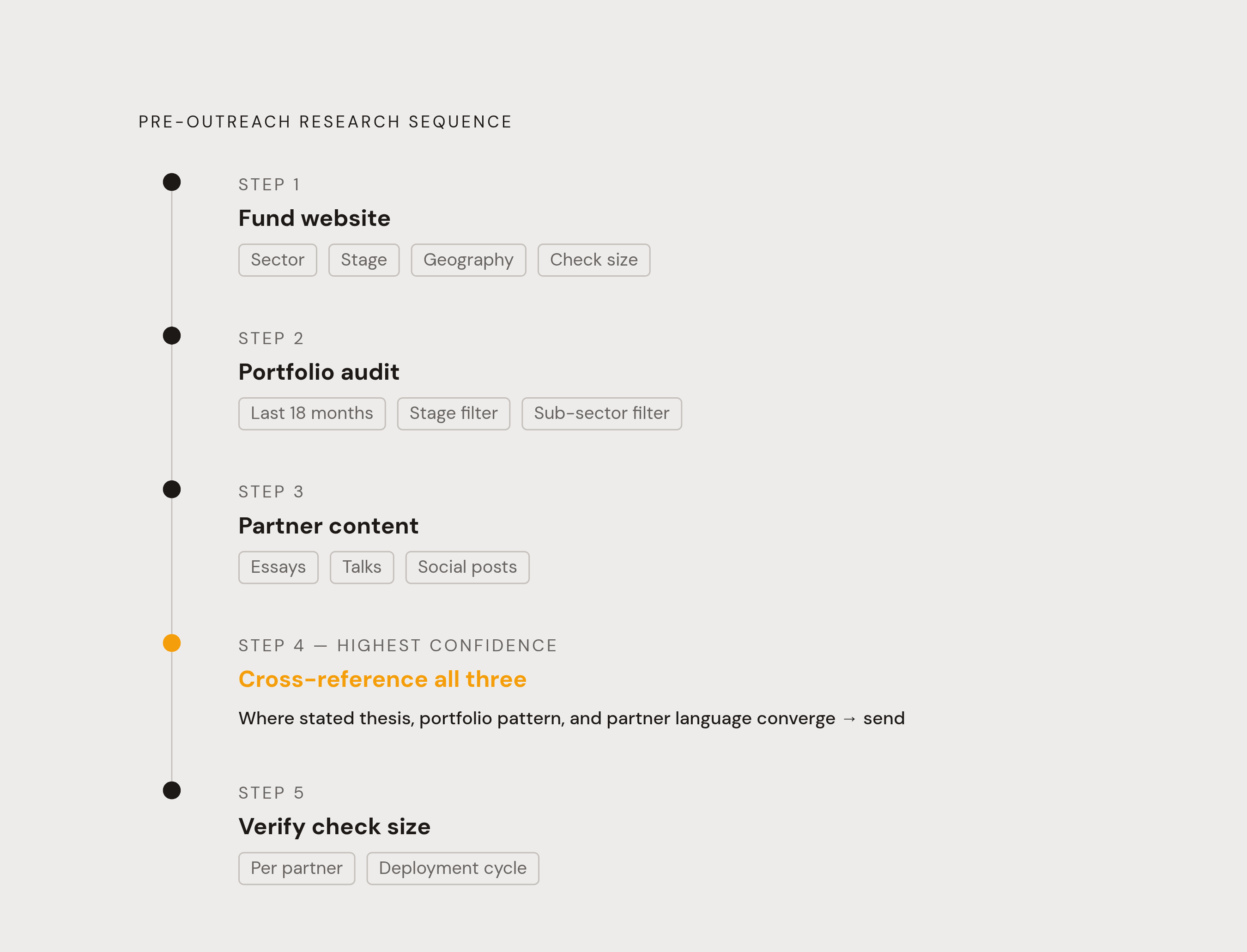
The research sequence itself runs in five steps. Start with the fund's website, treating the stated sector, stage, geography, and check size purely as starting coordinates, not conclusions. Move to a portfolio audit next, filtering the last eighteen months of deals by stage and sub-sector to identify the operational thesis that the marketing language describes only loosely. Third, read the partner's recent content: essays, talks, social posts, whatever reveals the thematic direction and the specific language they use to describe what excites them. Fourth, cross-reference all three; where the stated thesis, the portfolio pattern, and the partner's writing all point the same direction, confidence in fit is as high as pre-outreach research can get it. Fifth, verify current check size specifically, since different partners at the same fund write different sized checks, and those ranges shift as a fund matures through its deployment cycle.
Recency deserves its own filter. Flag any fund whose most recent disclosed investment in the relevant category is more than eighteen months old; that's often a sign the fund has moved into harvest mode and isn't leading new rounds in that space anymore, even if the category still sits on its homepage.
A newer category of AI-powered investor intelligence tools has emerged specifically to compress this workflow, surfacing thesis-level patterns, portfolio composition, warm intro paths, and deployment recency in one place rather than across a dozen browser tabs. The manual alternative, piecing this together from news searches, LinkedIn, and generic databases, tends to produce information that's inconsistent and often stale, and it taxes a founder's time at exactly the point in a raise when time is scarcest.
Warm path mapping should happen in parallel, not after. Mapping second-degree connections against a target fund's team page before any outreach goes out is worth the time, and portfolio founders backed by that fund are a particularly strong source, since they already have a working relationship with the partners a founder is trying to reach. Per waveup.com's data, thesis-matched targeting correlates with closing rounds 70% faster, which makes this research phase something closer to non-negotiable than optional homework.
Stage and market context a founder must know before targeting any investor in 2026
The 2026 fundraising environment is more stage-specific and more thesis-driven than it's been in recent memory. Late-stage rounds captured 68% of all North American funding in 2025, while seed investment dropped 9% year-over-year, according to Crunchbase's data. Fewer seed checks are getting written, but the ones that do get written are bigger: median seed post-money valuation hit $24M in Q4 2025, up from $18M in Q4 2024, per Carta's State of Private Markets report.
Stage benchmarks help calibrate expectations before outreach even starts. Pre-seed rounds average $500K to $2M, typically on SAFEs, with a median cap around $7.5M for checks under $250K. Seed rounds ran a median of $3M to $3.8M in 2025, with upper-quartile rounds reaching $5.6M and dilution landing in the 20 to 25 percent range. Series A got more expensive too: median pre-money valuation reached $49.3M in Q3 2025, with round sizes commonly falling between $5M and $20M, per CRV.
AI has its own separate benchmark, and founders outside that category need to treat it as a targeting variable rather than a universal yardstick. Fully half of all global VC funding in 2025 went to AI companies, $211 billion, up 85% year-over-year, per Crunchbase. AI Series A pre-money valuations hit $84M, nearly double the overall median, and AI seed-stage companies closed at a 42% valuation premium over non-AI peers. A non-AI founder who benchmarks against those numbers is setting an expectation no investor conversation will meet, and that mismatch becomes visible fast in negotiations.
Capital isn't scarce, exactly. It's cautious. U.S. VC dry powder was $307.8 billion entering 2025, per the NVCA's 2025 Yearbook, with more than $2.5 trillion on the sidelines globally. LPs are pushing GPs to deploy that capital, but the pressure is toward high-quality, thesis-matched deals specifically, not toward writing more checks broadly.
The graduation data shows that execution evidence now carries more weight in fundraising decisions than it once did. Only 15.4% of the 2022 seed cohort raised a Series A within two years, the lowest rate on record, compared with 30.6% for the 2018 cohort. Investors know that number. It's part of why they're scrutinizing execution more carefully before leading a seed round today than they were five years ago.
The practical implication for targeting: know which stage a fund is actively deploying into right now, this quarter, not which stage its bio says it "historically" prefers.
Writing the first email once the thesis is decoded
All of that research exists to produce one thing: an email a partner actually reads. Investors spend very little time reviewing a pitch deck on first pass, and seed-stage decks often get even less than that. That window is not forgiving of guesswork, and it rewards a founder who can demonstrate, in the first two sentences, that the fund's actual thesis and the founder's actual company are the same conversation.
The research done in the prior steps, the portfolio pattern, the partner's own language from a recent essay or interview, the confirmed check size and stage, should appear directly in that opening email, not as a separate research memo attached to it. A founder who references the specific sub-category a partner has been writing about, and ties it explicitly to what the company does, is doing the one thing that gets an email read past the first line: proving, in the fund's own language, that the fit isn't a guess.