Seed Round Fundraising Timeline Week by Week
Structured fundraising closes three times faster than improvisation.

What a seed round looks like in 2026: benchmarks before you build the plan
Fundraising in 2026 comes down to process discipline. A founder either runs the raise as a system, with weekly checkpoints and a live tracker, or lets it drift into a string of coffee meetings that eventually, hopefully, produces a wire. Global venture deployment climbed to $425 billion across more than 24,000 companies in 2025, up 30% year over year, with $311 billion in dry powder still sitting uncommitted. Capital is not the constraint. Structure is, and most founders never build one, which is the single biggest reason a raise that should take three months takes nine.
Carta's July 2026 software analysis put the seed median at $4.1 million, raised at a $24.3 million valuation, with 18% dilution. Sit with the valuation figure for a second: median post-money seed valuations hit an all-time high of $24 million in the fourth quarter of 2025, up from $18 million a year prior and $16 million two years before that. Round sizes are pulling valuations up, not the other way around, and a founder who doesn't understand that sequencing walks into a negotiation backward, arguing for a price the market hasn't actually offered him yet.
Sector changes the math more than most founders admit, and pretending otherwise is where a lot of decks go wrong before the first meeting even happens. AI seed rounds run about 1.3x larger than the broader median and price more than 40% higher on valuation. Non-AI B2B SaaS seeds price meaningfully higher on a pre-money basis than either figure. Consumer rounds land lower still, unless the traction numbers are genuinely unusual. A founder building a marketplace and pricing off an AI comp set isn't being ambitious, he's using the wrong map, and investors will notice before he does.
Dilution now runs in a tight band, 20% to 25%, with Carta's December 2025 software analysis putting the median at 19.5%. Get that number into the room before the first term sheet conversation starts. The 95th percentile seed raises several times the median, and founders routinely confuse "aggressive" with "outlier" when sizing their own round, which is how a founder ends up asking for a number the data doesn't support and burning credibility to get there.
Instrument choice is mostly settled at this point. Post-money SAFEs with a valuation cap are the default, and convertible notes have fallen to a small share of instruments used. Priced rounds still happen, but they add legal cost and two to four weeks most seed timelines can't spare. Here's the risk nobody prices in correctly: three or four uncapped or high-cap SAFEs feel harmless in isolation, right up until they all convert at once and the founder discovers the round diluted him twice as much as he modeled. Run total dilution across every instrument on the table from day one, not after the first one converts. Waiting until the priced round to do that math is how founders end up owning less of their own company than they thought, on the day it matters most.
How long the full arc takes
A typical seed round closes in 12 to 16 weeks from first meeting to wired funds, with the active fundraising window, first meeting to signed term sheet, running 6 to 10 weeks. The spread is wide: competitive rounds close under eight weeks, while thin metrics or a crowded category can drag the process past nine months.
For a priced round, the phases roughly break down as three weeks of prep, four weeks of meetings, four weeks of term sheet negotiation, and four weeks of confirmatory diligence and closing. SAFE-based rounds move faster because they skip most of the priced-round legal overhead. When a round gets genuinely competitive and multiple term sheets arrive at once, negotiations often compress into four to six weeks.
Nothing predicts speed better than locking a lead early. Founders who land a lead within the first four weeks of active fundraising close meaningfully faster than founders still hunting for one at week eight, and everything downstream, syndicate-building, diligence, closing mechanics, moves faster once a lead has put capital and reputation behind the round. Chase a lead late, and every other part of the process slows down waiting on it.
Run the math backward, not forward. If cash needs to hit the account by a given month, active fundraising has to start four to five months before that, not four to five weeks. The gap between seed and Series A has stretched meaningfully longer than founders typically plan for. A seed round today is financing roughly two years of runway, not one. Investors know that, and they negotiate harder and take longer on diligence because of it. Founders who count backward from the date the bank account runs dry, instead of the date they'd like to close, end up pitching from visible desperation. Investors price that in every single time, and no deck fixes it once it's showing.
Pre-launch (Weeks –8 to –4): what to build before you take a single meeting
Preparation should start 4 to 8 weeks before the first pitch meeting, and active pitching should begin with substantial runway still on the balance sheet. Seed rounds of all types routinely take several months from first meeting to close. Runway cushion is what lets a founder walk away from a bad term sheet without flinching. Cutting runway too thin makes that leverage disappear before the first meeting even happens, because everyone in the room can smell a founder who has to say yes.
Relationship-building starts earlier than most founders think to begin it, well before the formal raise. It looks unglamorous, made up of quarterly updates, casual conversations, an occasional warm introduction request, and the slow work of making sure 10 to 20 investors already understand the company's story before a deck ever gets sent. Founders who skip this step are starting cold with everyone in the room, and cold shows.
The real work of this window means assembling evidence, including retention curves and cohort data, pilot results, early ARR or MRR if it exists, a bottom-up revenue model running at least 24 months out, and a sharp answer for why this specific opportunity exists now and not two years ago or two years from now. Build the data room before the raise, not during it. That means the pitch deck, cap table, a financial model with 24-month projections, the SAFE or term sheet template in use, articles of incorporation, founder agreements, IP assignments, key customer contracts, and a live product metrics dashboard. Round sizing should target 18 to 24 months of runway, enough to hit a defined milestone without forcing another raise mid-execution. A seed round should fund one specific change in the company's risk profile. Nothing vaguer than that survives contact with a sharp investor.
Founders who spend at least 10 days on materials before the first meeting close at meaningfully higher rates than founders who start pitching day one. Skipping that prep costs an average of six weeks on the back end, in extended meetings and repeated follow-ups that better materials would have prevented the first time around. A no collected on a weak deck is a no forever. Investors do not circle back three months later to re-evaluate a company they already passed on, unless something dramatic has visibly changed in the meantime. Treat quality control in this window as a high-stakes activity that shapes the outcome of the raise.
Before Week 1 begins, the founder should already have a defensible deck, a complete data room, a 24-month model, a clean cap table, and a target investor list sorted into tiers. Anything short of that list is a founder starting the clock before the gun goes off.
Weeks 1–2: building a tiered investor list and mapping introduction paths
The target list for a seed round typically runs 80 to 120 investors, filtered on stage fit (they write checks at this size), sector fit (they've backed adjacent categories in the last 24 months), and check-size fit. Per DocSend, the average successful seed founder pitches roughly 60 investors, a useful correction for any founder who thinks ten good meetings will produce a round.
The list gets built in tiers, and the sequencing matters as much as the sorting. Tier 1, the dream leads with deep thesis alignment, roughly the top ten, gets approached last, once earlier meetings have produced real data points worth bringing to the table. Tier 2, the next 20 to 30, are strong fits, credible as leads or major participants, and they go early in the process to build momentum. Tier 3, the remaining investors on the list, are likely participants and followers, brought in only after a lead is secured.
Stage fit is not a detail to skip, and getting it wrong is one of the more common ways founders waste a quarter. Founders who spend the first three months of a seed raise pitching Series A funds, out of flattery or hope, routinely burn months on it: the A funds take the meeting out of curiosity, pass, and the founder mistakes the meeting itself for momentum. That single mismatch explains a chunk of the raises that stretch past seven months for no good reason.
Software exists to filter investors by sector, stage, and recent portfolio activity, and it beats sorting by name recognition, but the tool matters less than the introduction path. Mapping warm introduction paths for the majority of top targets before any outreach goes out determines the outcome more than the filtering software used to build the list. A cold email to the perfect investor gets ignored more often than a warm introduction to a mediocre one, and by 2026 a single unfiltered blast to a purchased list gets no response. Targeting precision and introduction quality are the two variables a founder actually controls here, so control them.
By the end of Week 2, the deliverable is concrete: a tiered, sourced list of 60 to 100 investors, warm intro paths identified, outreach sequences drafted, and a pipeline tracker live to log every touchpoint from that point forward.
Weeks 1–3 (parallel): building the pitch deck and investor narrative
The deck's only job is to earn a meeting. It does not close a round, and founders who treat it like a closing document overbuild it, stuffing in appendices and financial detail nobody asked for at this stage. Investors spend an average of roughly three minutes and forty-four seconds reading a deck before deciding whether to take the call, so every slide has to answer one specific question and hand the reader cleanly to the next.
Five slides carry the actual weight: problem (the market gap and the pain it causes), solution (the product's specific value), market opportunity (sized bottom-up, never top-down), traction (the most scrutinized slide at seed, whatever form the proof takes), and team (why these particular founders are positioned to solve this particular problem). The strongest decks don't read as sections stapled together. They read as a sequence of proof that opens with an insight sharp enough to make the problem feel real before the solution ever appears on screen.
Getting stage calibration wrong can undercut a pitch that's otherwise solid. A pre-seed narrative can lean on founder insight and depth of problem understanding. A seed narrative has to carry traction evidence, and the shift from "we understand this problem" to "the market is already responding" is the single biggest jump in what a deck needs to prove between the two stages.
Sector calibration compounds on top of that. A B2B SaaS company needs cohort retention, paid conversion, usage depth, and gross margin; a pipeline of interested leads without conversion history reads as a placeholder, not proof. Consumer companies need retention by cohort, frequency, and organic acquisition, since download counts and waitlist size don't demonstrate durable behavior. Marketplaces need completed transactions, repeat rate, fill rate, and time to match, because gross listings without liquidity say nothing about whether the model works. AI companies, where revenue is often still thin, carry the narrative on a defensible data angle, technical performance, and team credibility instead.
By the end of Week 3, the deliverable is a 12 to 15 slide deck, defensible slide by slide, reviewed by at least one investor willing to give blunt feedback, and locked before it goes out to a single first meeting.
Weeks 3–6: running first meetings and managing the funnel actively
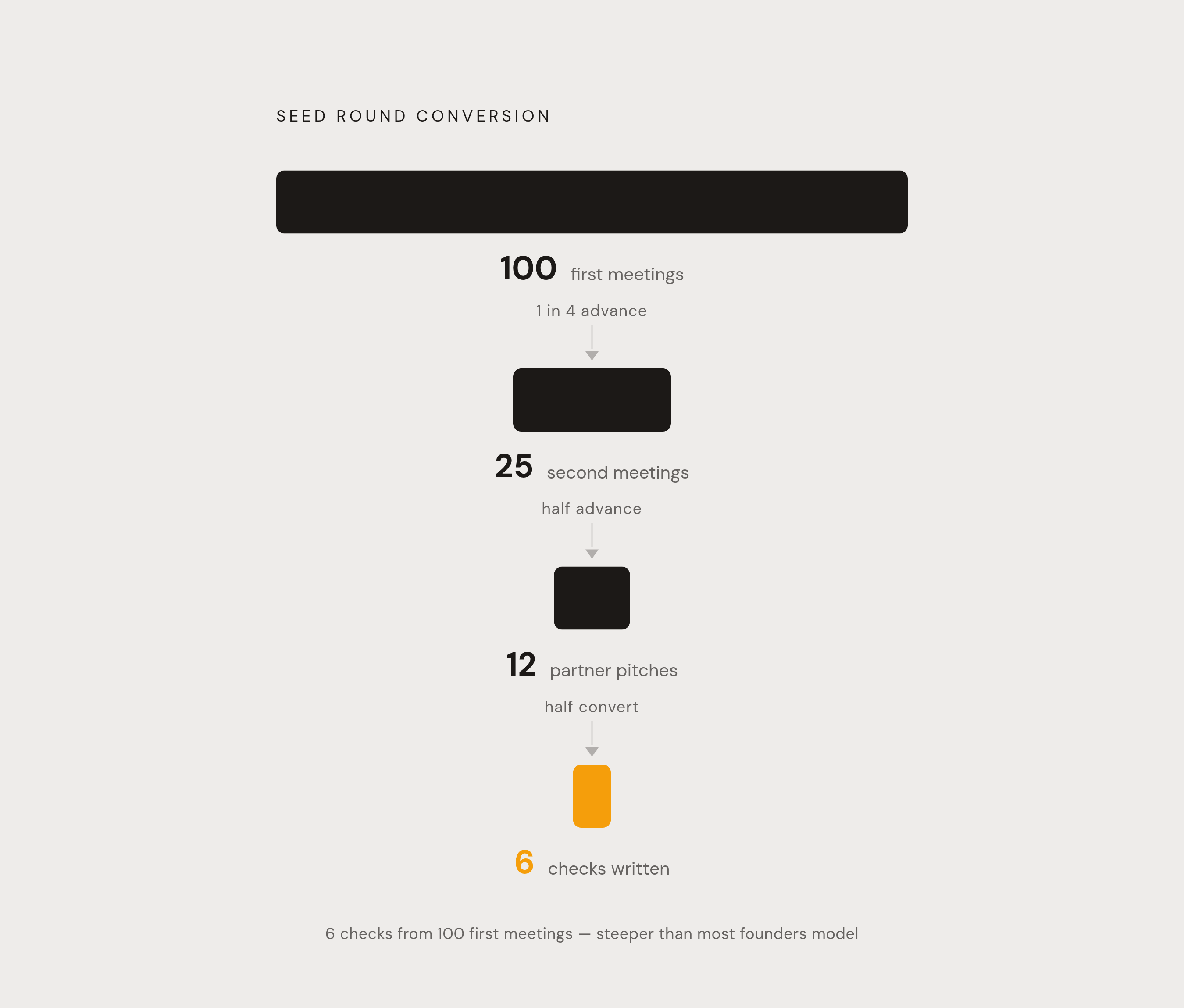
The target cadence is 8 to 12 first meetings per week, each running 30 to 45 minutes and functioning as a qualification conversation. The funnel math is unforgiving: roughly a quarter of first meetings advance to a second meeting, about half of those advance to a partner pitch or serious follow-up, and about half of those convert to a check. Run that math forward: a seed round typically needs 60 to 100 first meetings to close. That is why the Week 1 and 2 list was sized the way it was, and a founder who builds a list of 25 investors is not being efficient, he's guaranteeing the round runs short.
The variable founders mismanage most is parallelism. Sixty conversations run sequentially, waiting for each reply before starting the next, burn six months without anyone doing anything wrong. Running the same sixty conversations in overlapping two-week clusters compresses the timeline down toward ten weeks, because investors read momentum socially: visible competition for a deal shortens the internal approval process on the other side of the table.
Tier sequencing follows the plan built in Weeks 1 and 2. Open with Tier 2 to build momentum and gather honest market feedback, use that feedback to sharpen the pitch before Tier 1 leads see it, and bring Tier 3 in only after a lead has signed.
Pipeline discipline is what actually separates founders who close on schedule from founders who don't. Every contact, every meeting date, every follow-up sent, every stage transition belongs in a tracker, because founders who monitor funnel conversion actively finish weeks ahead of equally strong peers who are simply waiting for the next email to land. Active diligence at seed means reference calls with customers, a real review of the data room, a second or third partner conversation, and answers to diligence questions returned within 24 hours. A stale response kills more deals than a bad answer ever does.
By the Week 6 checkpoint, there should be two to four investors in active diligence. If there aren't, that's a signal to take a hard look at targeting, narrative, or tier fit. The trap most founders fall into here is mistaking enthusiasm for progress. "We love what you're building" is not a commitment, and every meeting needs an explicit next-step ask, tracked and followed up on, or the pipeline will look busier than it actually is.
Weeks 5–8
This is where the funnel built in Weeks 3 through 6 either converts into term sheets or stalls, and from the outside those two outcomes look identical for longer than founders expect. Second and third meetings with Tier 2 and Tier 1 investors should be landing now, alongside the first serious partner-level conversations for whichever fund is closest to leading.
The work shifts from volume to conversion. Instead of adding new names, the priority becomes closing the loop with everyone already in the pipeline: pushing for a clear yes, no, or a specific stated condition from every investor still active in diligence. A founder still generating fresh first meetings in Week 7 without a lead identified is behind the pace these benchmarks describe, and the fix at that point is to revisit targeting, not to pile more outreach on top of a process that already isn't converting.
Sources
- How Long Does It Take to Raise a Seed Round? (2026 Timeline)
- Seed Fundraising Guide: How to Raise a Seed Round in 2026
- How Long Does a Seed Round Take? 12 Founders Share 2026 Timelines
- qubit.capital
- qubit.capital
- Average Seed Valuation in 2026: $24M Median, But Only AI Gets That (Carta Data) | Flowjam
- Median Seed Round Size by Industry in 2026 (Data)
- Seed valuation benchmarks 2026: look up your sector, stage and SAFE cap