Seed Round Fundraising Timeline and Sequencing
Seed fundraising now takes three to six months and requires contacting 200-plus investors.
Global startup funding climbed to roughly $314 billion in 2024, a number that reads like good news for anyone thinking about raising a seed round. It isn't, not in the way founders assume. Deal count has shrunk even as the money keeps flowing, which means fewer rounds are getting done and the ones that close are getting bigger and harder to reach. Data on seed activity in early 2025 showed just over 400 new seed rounds completed in the first quarter, down close to 30% from the year before, and total dollars raised fell even more sharply. At the same time, median pre-money valuations at seed rose to around $16 million in that same quarter, up nearly 20% year over year. Fewer deals, bigger checks, higher bars: that's the seed market right now, and it rewards founders who treat fundraising as a sequenced operational process rather than a networking exercise.
Seed today looks like Series A did a few years back, in the expectations investors bring to the table. That's not a cyclical dip that reverses itself once rates come down. It's a structural shift in what investors expect to see before they'll write a check. Layer on the AI effect, where the large majority of early-stage dollars in recent quarters have gone to AI companies, and non-AI founders face a market that's tighter than the headline funding numbers suggest. Investor Dimitriy Mishin summed up the mood outside AI bluntly: a founder can have a great product, a strong team, and real revenue growth, and still not be "in fashion" right now. None of that is fixable by working harder on the pitch deck. What is fixable is how a founder sequences the raise itself, and that's the part almost entirely within a founder's control.
What the realistic seed fundraising timeline looks like, phase by phase
Seed rounds run three to six months of active fundraising once a founder actually opens the process, and the average round takes around 115 days to close from first outreach. That clock doesn't start when a founder decides they want to raise. It starts the moment the first email goes out, which is why so many founders feel like their raise is taking twice as long as it should: they're counting from intention, not from action.
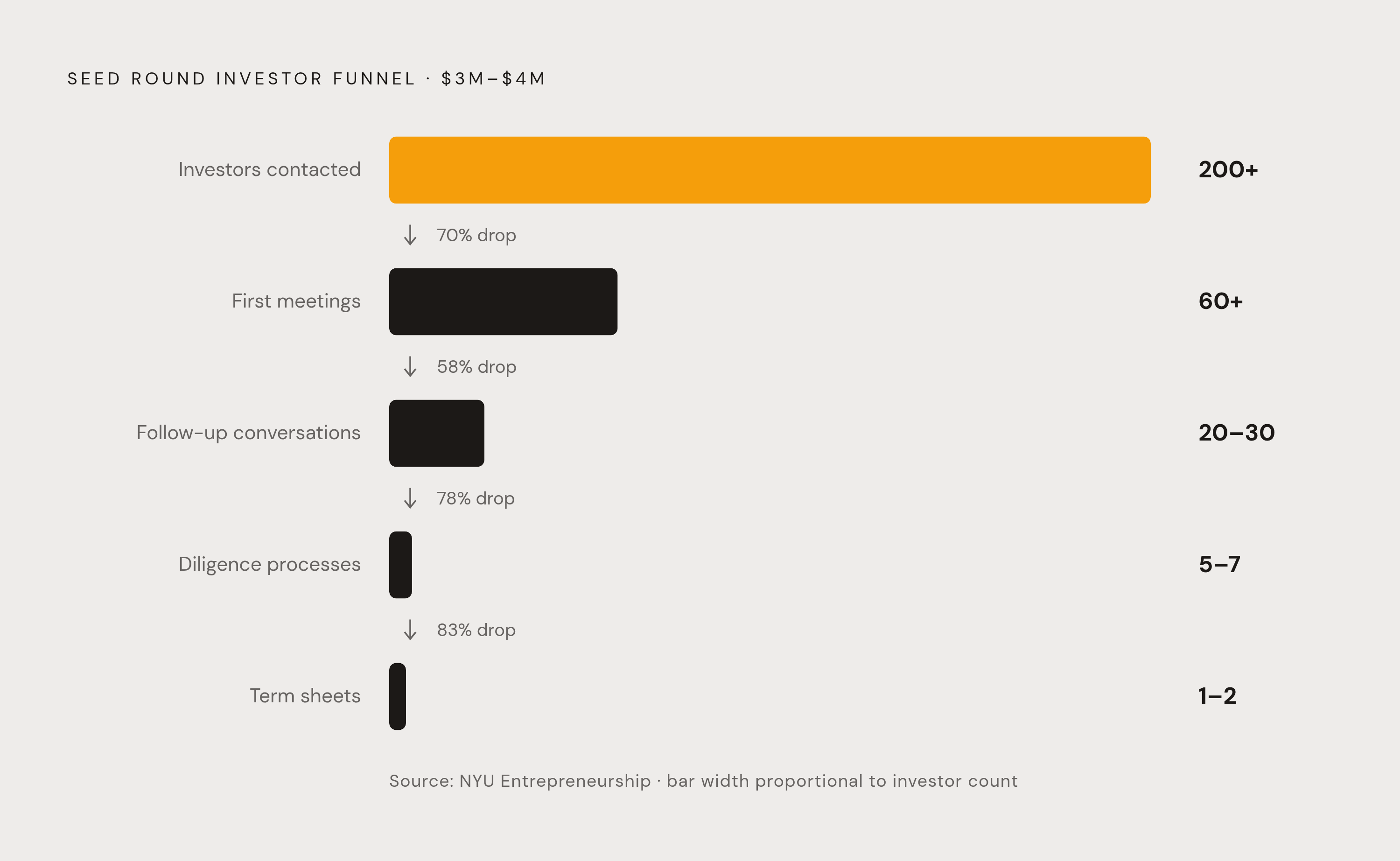
The volume required is larger than most first-time founders expect. Closing a $3 million to $4 million seed round typically means contacting over 200 investors: something like 60-plus first meetings, 20 to 30 follow-up conversations, five to seven diligence processes, and one or two actual term sheets, according to NYU Entrepreneurship research. The shape of that funnel matters as much as the total count. A founder who gets 60 first meetings but only two follow-ups has a narrative problem, not a networking problem.
Round sizes have crept up. Median seed cash raises have climbed to a few million dollars, and PitchBook-NVCA data put the median round size at $3.8 million in the third quarter of 2025, up from $3.1 million a year prior. Healthcare rounds run higher, with medians near $4.6 million, and AI-focused startups are commanding valuations meaningfully above the broader seed market simply because of category heat. Dilution at seed typically is between 15% and 25%, though that range depends heavily on instrument choice and whether earlier unpriced rounds have already stacked on the cap table, which gets covered below.
The raise breaks into four phases: pre-raise preparation that runs six to twelve months before the round formally opens, active outreach and pipeline management that's the three-to-six-month sprint, diligence and term sheet negotiation, and close followed by post-close runway planning. Conflate these phases, and the timeline looks shorter on a calendar but runs longer in practice. Skip preparation and jump straight to outreach, and a founder ends up doing relationship-building in real time, in front of investors who are deciding whether to trust them. There's also a calendar effect to plan around, since deal activity in the fourth quarter historically runs higher than in the first quarter, so timing when to open a round is itself a sequencing decision, not an afterthought.
The preparation phase that most founders skip or rush, and why it determines everything downstream
Founders who raise well start building investor relationships six to twelve months before they need the money. By the time they formally open the round, half the conversations they need are already warm. That's not luck. It's the direct result of treating the months before a raise as an active phase of the raise itself, rather than a quiet period before the "real" work begins.
Preparation has specific components, and none of them are optional. Investor mapping comes first: figuring out who actually invests at seed stage, in the relevant sector, and has capacity left in their current fund, before sending a single email. Monthly updates to warm leads during this period convert cold introductions into informed conversations, so that by the time a founder asks for a meeting, the investor already knows the company's trajectory.
Narrative matters differently at seed than at later stages. A seed pitch is a problem, market, and team story, not yet a metrics story, and it needs to survive pressure-testing before the round opens rather than during a pitch meeting. Materials need to work without the founder standing there to explain them: data from DocSend found investors spend an average of three minutes and 44 seconds reviewing a seed-stage deck, which leaves almost no room for a slide that needs verbal context to make sense.
This is also the phase where instrument decisions belong, not the phase where a term sheet forces the decision. Founders who skip preparation and open cold pay for it twice: early meetings get wasted on investors who were never going to write the check, and negative signals travel through investor networks faster than most founders expect. The pre-raise period isn't passive. It's intelligence gathering: which funds are actively deploying, which are between vintages and quiet, and which portfolio founders can make a warm introduction happen.
How instrument choice at seed interacts with dilution sequencing in ways that surprise most founders
SAFEs dominate seed-stage fundraising, and the standard post-money SAFE format has become close to universal because it's cheap: legal costs for a SAFE close are a fraction of what a priced round requires, which can run $15,000 to $50,000. But deal size, not founder preference, tends to determine which structure actually fits. Rounds above $5 million lean toward priced equity, while the $3 million to $5 million range is the real decision zone where either instrument can work.
The dilution trap is where founders get surprised. Multiple SAFEs raised sequentially stack invisibly on the cap table, since none of them convert until a priced round happens. By the time they do convert, effective dilution at seed can end up well above the 15% to 25% range founders think they signed up for. The large majority of SAFEs issued in 2025 used a valuation cap with no discount, making the cap-only structure the default, and its mechanics need to be modeled out before a founder signs, not after.
Cap table health at seed determines how the Series A conversation goes. The healthiest pre-Series A cap tables keep founders in a strong majority position, with seed investors and the employee option pool together making up the remainder. Fragmented angel ownership, or founder equity that's dropped below 60%, creates friction the moment Series A investors start reviewing the table. After a seed round closes, the median founding team owns around 56% of the company, and that number only falls further by Series A. The instrument decision made early in preparation is still shaping negotiating leverage well into the Series A conversation.
Building a qualified investor target list before outreach begins, and why list quality beats list size
A working list of genuinely relevant investors is the floor for a seed raise, not the ceiling. Relevant means investing at the right stage, with real history in the sector, and with capacity left in the current fund to write a new check. Founders who skip this step and send templated outreach to hundreds of mismatched names get reply rates that reflect it. That's not a pitch problem. Most of those 400 firms were structurally never going to invest, regardless of how sharp the deck was.
Qualification means answering four questions for every name on the list. Does this fund actually write seed checks, or only lead Series A rounds? Has this investor written a check in this category before, or would this be their first? Is the fund actively deploying capital right now, or sitting in harvest mode toward the end of its cycle? And does the target round size match what this fund typically writes as a check?
Tools exist to make this filtering faster. Crunchbase offers a filterable investor database with funding history and portfolio data, and shipped an AI-powered investor search feature in 2024. Harmonic uses machine learning to match investors across sector, stage, and portfolio fit. A handful of newer platforms built specifically for seed-stage founders combine investor data with outreach tracking in one place. None of these tools replace the judgment of qualifying a fund manually, but they cut the research time down considerably.
Warm introductions convert at far higher rates than cold outreach, which is why the targeting phase should also map second-degree connections to each investor on the list. A portfolio founder introduction is among the most effective routes into a first meeting. The output of this phase isn't a spreadsheet full of names. It's a tiered list: who to approach first to build early momentum, who to hold in reserve until a lead investor emerges, and who requires a referral before any outreach makes sense at all.
Running the active raise as a pipeline: sequencing outreach, pacing meetings, and managing momentum
The most common sequencing mistake is spreading meetings across months instead of compressing them into weeks. Investors talk to each other constantly, and simultaneous interest from multiple firms signals competitive demand. Meetings strung out sequentially over months signal the opposite: that no one else is paying attention. Compressed outreach batching, scheduling first meetings in a concentrated window of a few weeks rather than letting them trickle out, gets multiple investors hearing about the round at roughly the same time.
The funnel needs active management at every step: 200-plus contacts narrowing to 60-plus first meetings, then 20 to 30 follow-ups, five to seven diligence processes, and finally one or two term sheets. Each stage does a different job on a different timeline. Stalling at the follow-up stage usually means the narrative needs sharpening, not that the founder needs to email more investors.
CRM infrastructure isn't a nice-to-have here. Founders who close rounds efficiently are tracking every conversation, every follow-up date, and every warm referral path somewhere other than memory, using tools like HubSpot, Attio, or fundraising-specific platforms with pipeline views built for this exact purpose. Weekly pipeline reviews, checking what's advancing, what's gone quiet, and what needs a referral nudge, turn the raise into something closer to a sales operation than a string of disconnected coffee chats.
Pacing determines leverage. The first term sheet a founder gets isn't the finish line, it's the opening move: having multiple firms in diligence at the same time is what actually creates room to negotiate valuation, board composition, and protective provisions. Meanwhile, updates sent to warm leads who aren't yet formally in the pipeline keep the relationship at temperature and give the founder a re-entry point if the raise runs longer than planned.
What diligence and close require, and how to avoid stalling in the final stretch
Diligence at seed is lighter than at Series A, but it still requires organized paperwork: a clean cap table, a financial model, incorporation documents, IP assignments, and any customer contracts or letters of intent already in hand. Founders who stall in diligence are almost always the ones scrambling to assemble these materials after an investor asks for them, instead of having them ready before the question comes.
Seed diligence leans heavily on the team, not just the numbers. Investor reference calls, background checks on founders, and product demos are standard practice, and having references lined up in advance shaves real time off this stage. The legal cost gap reinforces why the instrument decision matters this much: a SAFE close runs roughly $1,500 to $5,000, while a priced round at seed runs $25,000 to $50,000. That's a decision made months earlier that now appears as a real line item.
Term sheet negotiation centers on a handful of variables: the valuation cap, the dilution percentage, pro-rata rights, and information rights. Founders negotiating without a qualified attorney in the room routinely leave value on the table, or accept provisions that come back to complicate the Series A conversation later. For SAFEs, rolling closes let founders bring investors in one at a time as commitments land, announcing each close rather than waiting for the full round to be subscribed before saying anything publicly. That keeps momentum visible.
The hidden risk in this stretch is treating a verbal commitment as a closed deal. A round with commitments on paper that hasn't actually wired and closed can unravel fast, so legal execution needs to take priority over handshake agreements. Once terms are agreed, legal documentation takes meaningful time to finalize, and that window belongs in the calendar from the preparation phase, not as a surprise sprung on the founder at the end.
The day the seed closes is the start of the Series A clock, not the end of the fundraising process
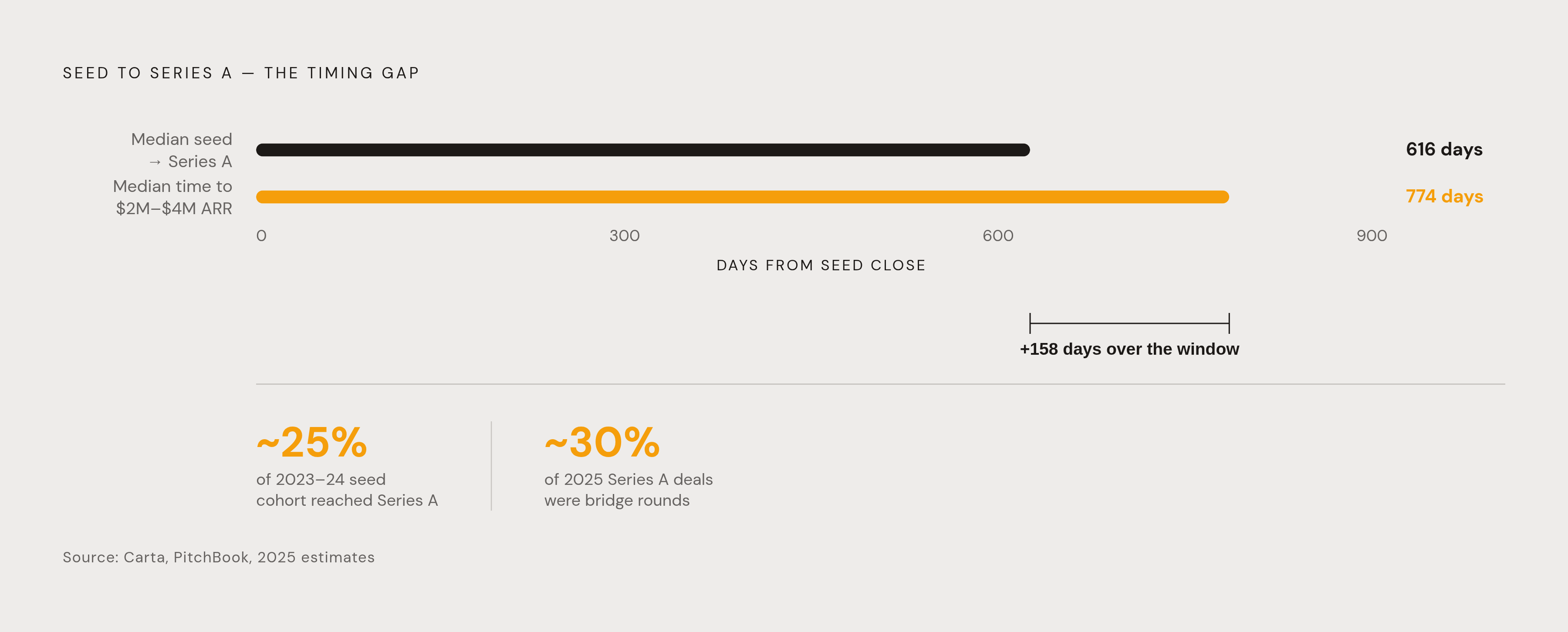
The median gap between seed and Series A reached 616 days in 2025, just over 20 months, and that stretch is the real test of whether a founder ever raises again. Series A investors now expect $2 million to $4 million in ARR, up from roughly $1 million a few years ago, and the median time to hit that revenue threshold after seed runs around 774 days. Do the math, and a lot of founders are walking into Series A conversations before they've actually cleared the bar, negotiating from a position of weakness rather than strength.
The numbers on conversion are sobering. Only around a quarter of seed-funded startups that raised a meaningful seed round or more in 2023 and 2024 made it to Series A. The squeeze narrows the field to a quarter of seed-funded startups reaching Series A, and what separates the founders who make it through is largely what they did with the runway in between. Nearly 30% of Series A deals in 2025 were bridge rounds, meaning founders raising extra runway specifically to hit milestones they hadn't reached yet, a clear sign that a lot of seed rounds close without any real milestone map for the 18 to 24 months that follow.
Preparing for Series A starts the day the seed round closes, not eighteen months later when the metrics start to matter. That means building the metrics story from month one, keeping monthly updates flowing to investor relationships instead of letting them go cold, and hitting the revenue and retention numbers institutional investors now expect as table stakes. A founder who raises $3 million to $5 million at seed without a 24-to-30-month operating plan behind it will walk into Series A meetings without leverage, and runway planning at that point stops being a finance exercise and becomes a sequencing decision with real consequences.
The founders who close seed rounds with discipline, meaning targeted investor lists instead of mass outreach, compressed timelines instead of months of drift, and clean cap tables instead of stacked SAFEs, are consistently the same founders who show up to Series A conversations with leverage intact. The habits built during the seed raise don't stay contained to the seed raise. They compound forward, for better or worse, into every round that follows.
Sources
- Startup Funding Rounds: Pre-Seed to IPO [Full Guide]
- Fundraising Timeline: From Seed to Series A - Phoenix Strategy Group
- Seasonal Trends in Seed and Series A Rounds - Phoenix Strategy Group
- How to Raise a Seed Round: Timeline, Terms, and What VCs Want to See - elev-x
- startupfundraising.com
- startupfundraising.com
- startuplawyer.com
- finta.ai