Building a Targeted Investor List From Scratch Without Warm Intros
Research and specificity matter more than warm intros when building your investor list.
Building an investor list without warm intros is a research problem, not a numbers problem. Founders who treat it that way raise money faster than founders who just send more emails. The absence of a warm intro feels like a wall. That feeling is inaccurate, since the absence of a warm intro is not actually a wall.
Warm intros are a distribution mechanism, nothing more. They get an email opened faster and sort a stranger into "worth a reply" instead of "spam." What they don't do is answer the question that actually closes a raise: does this fund invest in your geography, at your stage, with a check size that matches your round, and with a thesis that genuinely fits your company? That question gets answered the same way whether the email opens with "our mutual friend suggested" or with nothing. The intro changes how fast the door opens. It says nothing about which door to knock on.
The specificity of the targeting separates founders who close rounds from founders who send hundreds of emails into the void. It's the specificity of the targeting.
Information asymmetry is the deeper issue, and it runs one direction. Investors sit inside a data-rich environment: they see each other's deal flow, track founder networks, and read the signals moving through their own portfolio companies. Founders historically saw almost none of this. That gap has narrowed, but only for founders willing to run list-building like an actual intelligence operation, pulling from disclosed deal data, portfolio maps, and public statements instead of guessing from a homepage.
What the current fundraising environment means for list-building strategy
Money is badly distributed right now, and that distribution has direct consequences for anyone building a target list from a cold start. Global venture deployment hit $425 billion across more than 24,000 companies in 2025, up roughly 30% year over year. That sounds like an environment flush with opportunity, and in aggregate it is. The increase is not spread evenly: late-stage rounds and AI mega-deals are pulling a disproportionate share of that total. The seed and pre-seed funds a first-time founder is actually trying to reach are operating in a far tighter pocket of that $425 billion than the headline number suggests.
Sector concentration sharpens the problem further. More than 70% of global startup capital in the second quarter of 2026 went to AI-focused companies. A company sitting outside that category should assume a large share of nominally "active" funds simply aren't writing checks in its direction right now, regardless of what the website says about sector focus. Sector affiliation now shapes not just who agrees to meet, but what valuation gets discussed once they do.
This changes what a target list actually needs to capture. The investor universe isn't a static roster where a fund, once tagged "seed, B2B SaaS," stays tagged that way forever. Recency of deal activity is the precondition that makes every other filter mean anything. A list built on stale information is a different, worse thing than a smaller version of a good list. It's a different, worse thing.
Investor conversations themselves have shifted too. Questions about data moats, inference costs, and foundation-model dependency risk are now standard opening moves in a first meeting, even for companies that aren't AI companies in any narrow sense. That changes which investors are genuinely relevant to a business, independent of whatever sector tag a fund uses to describe itself publicly.
The four qualification filters every investor must pass before entering your list
The operating principle here is qualification over volume, and the case for it isn't close. A tightly filtered list of 50 to 80 investors genuinely matched to the company outperforms a list ten times that size stuffed with poor fits https://aspireapp.com/us/blog/investors-for-startup. A bigger list feels like more effort. Mostly it's just more noise, and noise costs time on both sides of the table.
Four filters decide who earns a spot on the list. The first is geography: does the fund actually invest where the company operates or is incorporated? Many funds carry explicit regional mandates, and the fastest way to confirm one isn't a database search but a look at the fund's own site alongside its last several disclosed deals.
The second filter is stage, and it's where most cold lists fall apart fastest. A fund that led Series B rounds over the last year isn't a seed investor, no matter what language sits on its "about" page describing itself as doing "early stage" work. Website copy is aspirational at best and outdated at worst, and a founder who trusts it over actual deal history is building a list on fiction.
The third filter is check size, and it has a hard mathematical floor. A fund writing $200,000 checks can't credibly lead a round that requires a $1 million minimum commitment, and chasing that fund for a lead position wastes time for everyone involved. Fit here is arithmetic, plain and simple. The fourth filter, thesis fit, gets its own treatment below, because reading a fund's actual thesis, as opposed to its stated one, takes more than a checklist. Confirm it against the last 12 months of disclosed deals, not their website copy.
A sourced map of investor databases and discovery tools
The starting point for any cold list is a database indexing investor profiles, portfolio history, and round activity, and Crunchbase remains one of the largest resources of this kind. Founders can filter by industry focus, investment stage, geography, and portfolio history, and the platform expanded its AI-powered search and investor recommendation features through 2025 and into 2026. The move that actually produces results is narrower than most founders expect: search for funding rounds in the specific sector, filter by stage and date, and identify not the fund but the individual partner who led the deal. That partner is who gets contacted.
AngelList works differently, as a tool for validating and qualifying investors who keep active, stated-thesis profiles. A profile reading "B2B SaaS, seed stage" against a consumer app pitch means that investor comes off the list immediately, no further research needed. OpenVC occupies a distinct and, for a cold founder, especially useful niche: it lists investors who've opted in to cold outreach directly through the platform, with a stated thesis and a preferred contact method attached. For a founder with no warm path at all, that opt-in signal is close to the highest-leverage starting point available, since it removes the guesswork and confirms that cold contact is welcome.
Beyond the core databases sit tools built for portfolio mapping and conflict checking. Signal by NFX and Landscape.vc both help founders understand a fund's existing portfolio composition and flag whether a competing investment already sits inside it, a detail founders need to know before a first call rather than during one. A separate and growing category uses machine learning to match founders to investors by sector, stage, and portfolio fit, with Harmonic cited as one example, and this category has expanded as compute costs have dropped.
None of these tools, alone, close the real gap. A traditional database confirms a fund exists and has invested somewhere near a company's broad sector. It can't say if that fund is actively deploying capital this quarter, if its thesis has quietly shifted since its last raise, or which specific partner is currently championing deals in the relevant space. That second layer comes from combining database output with fund-level primary research: recent press coverage, partner posts, podcast appearances, and LP letters where they happen to be public.
Segmenting your list so it functions as a ranked pipeline, not a flat spreadsheet
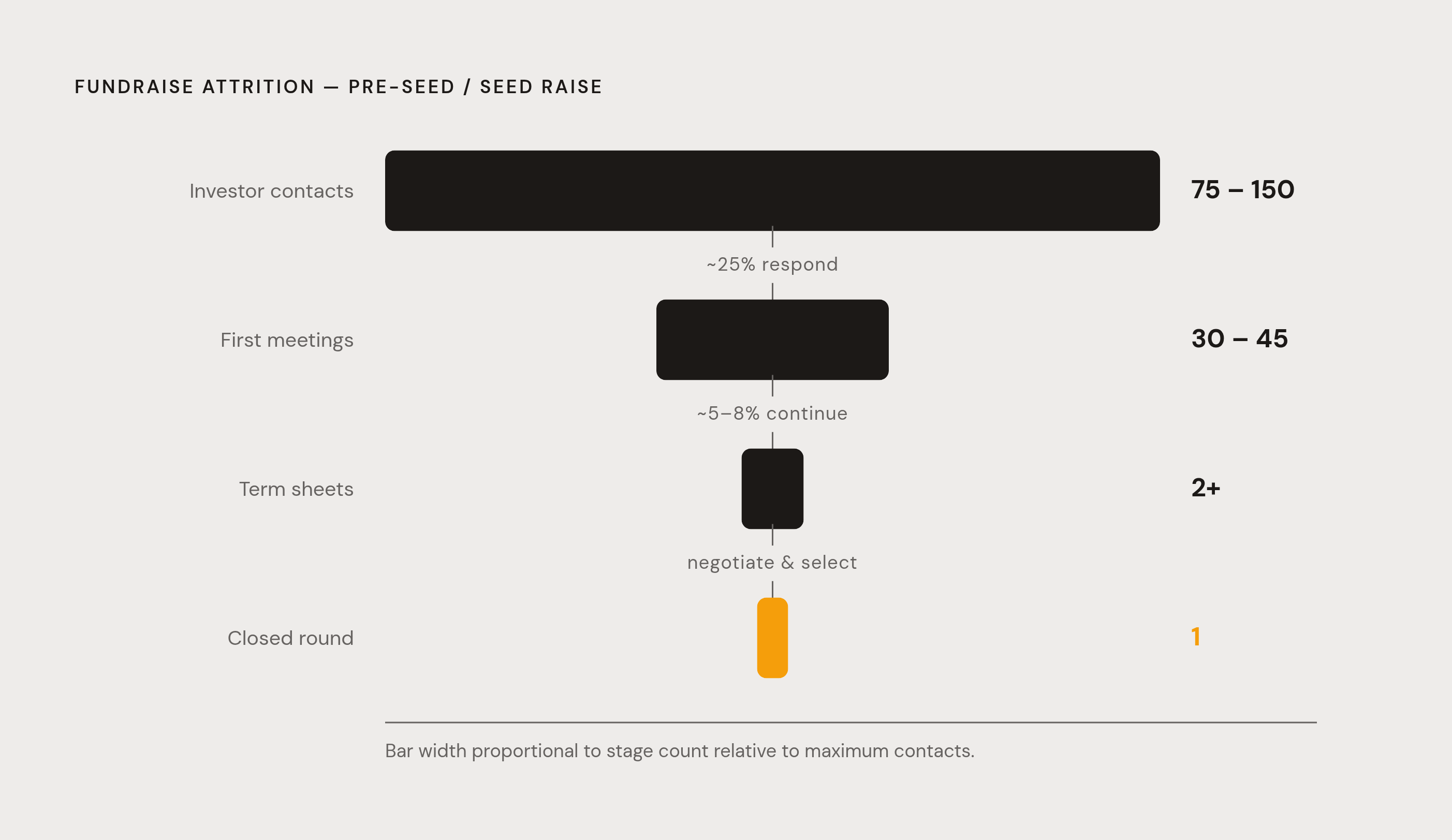
Funnel math sets the size and shape of the list before a single name gets added. A typical pre-seed or seed raise needs 75 to 150 warm-ish investor contacts loaded into a CRM to generate 30 to 45 first meetings, two or more term sheets, and one closed round https://waveup.com/blog/a-step-by-step-guide-on-investor-outreach-for-startups/. That attrition reflects the expected shape of the funnel. A list that ignores it, either by being too small to survive the drop-off or too large to manage with any care, sets the raise up to fail before outreach even starts.
Three dimensions of segmentation turn a flat spreadsheet into something that functions like an actual pipeline. The first is conviction tier: rank investors by how many of the four qualification filters they pass, not alphabetically and not by brand recognition. Tier 1 investors pass all four filters, have a recent deal in the exact sub-sector, and count among their partners someone who's written or spoken publicly about the relevant thesis. Tier 2 passes three of four, usually with a sector that's adjacent rather than exact but still plausible. Tier 3 passes only two filters and is worth contacting only once Tiers 1 and 2 are exhausted.
The second dimension is access path. For each name on the list, mark the route in as cold, community-adjacent (shared accelerator, shared portfolio founder, overlapping community), or genuinely warm. Portfolio founders already backed by the target fund represent the single highest-leverage warm path that exists, because their referral carries trust inside the firm that no other kind of introduction replicates.
The third dimension is timing signal. A fund can pass every other filter and still be the wrong contact this quarter if it's two years into a fund life cycle with most of its capital already committed elsewhere. This dimension flags investors whose recent activity suggests active deployment (a new fund closed in the last 18 months, recent deals in the relevant sector) against those who may be sitting in a harvesting cycle instead.
Reading an investor's actual thesis versus their stated one
Fund websites describe a thesis as it existed the moment the fund launched. Actual investment behavior, visible in disclosed deals, drifts from that stated position over time, especially once a fund has deployed half its capital or closed a new vehicle with a different mandate attached. Treating the "about" page as gospel is one of the more common, and more expensive, mistakes in cold list-building.
The fix is to read the revealed thesis instead of the stated one, noting the stage at entry, the check size, the sub-category within the sector, and the founder profile the fund tends to back.
Content signals fill in the gaps that deal data alone leaves open. A partner's blog posts, podcast appearances, public talks, and social posts from the last six months are often the most current read available on where conviction actually sits, more current than the fund's own website and more specific than any database entry. A partner who's spent the last two quarters publicly writing about supply chain infrastructure is telling you, directly, where attention and check-writing energy currently point.
Portfolio conflict checks belong in this same stage, not after a first meeting has already happened. A fund that's backed a direct competitor won't back a second company in the same lane no matter how sharp the pitch is. Finding this out during list-building costs nothing. Finding it out in a live meeting costs a slot on the calendar that could've gone to someone else.
What warm-intro math tells cold founders about where to spend their research time
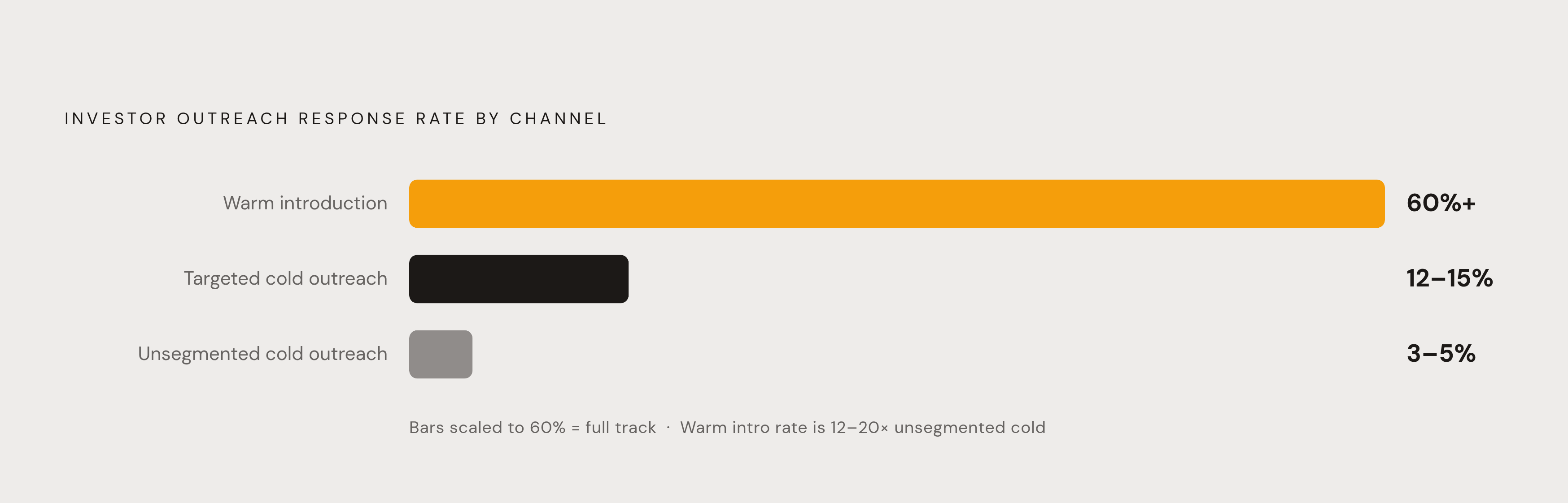
The conversion gap between warm and cold outreach is large enough to dictate how research time gets allocated, and the numbers aren't subtle. Warm introductions convert at response rates of 60% or higher, while unsegmented cold outreach without personalization runs 3% to 5%. A founder without any warm path isn't starting at zero, but is starting well behind, and the gap is wide enough that finding even an indirect warm path is worth serious research investment before going cold at all.
This turns warm-path mapping into a discipline in its own right, not an afterthought. For every Tier 1 investor on the list, the research task is to look for second-degree connections through LinkedIn, shared accelerator cohorts, shared portfolio founders, or overlapping domain communities. The goal is narrow: find one credible connector who can make an honest introduction, rather than stretching a thin acquaintance into something it isn't.
The strongest version of this path runs through a fund's own portfolio. A referral from a founder the target fund has already backed carries a level of trust inside that firm that no cold email, however well written, can replicate. That means a meaningful share of list-building time should go toward mapping a target fund's portfolio companies and identifying which of those founders might make an introduction, treating that mapping work as seriously as researching the fund itself.
How AI-powered tools change what is possible for a solo founder building a list from scratch
Compute costs have dropped far enough that AI-driven investor prospecting, surfacing relevant partners, pulling recent deal activity, tailoring outreach language to a fund's specific thesis, is now something a solo founder can run without a staff of analysts. That's a real shift from a few years ago, when this kind of research depth was mostly available to teams with dedicated business development headcount. Personalization at scale used to require a team large enough to write a custom message for every fund on the list, and now it doesn't.
Where these tools genuinely help is pattern-matching across large investor datasets to surface thesis fit, pulling recent deal activity and public content signals into one place, and automating the mechanical parts of list enrichment, contact details, fund size, recent raises, so a founder's actual time goes toward judgment calls rather than data entry. That's meaningful time saved, and it changes what "doing the research properly" costs in hours.
What these tools can't do is replace judgment about how a fund operates internally. No dataset tells a founder whether a specific partner is currently championing deals inside the firm's investment committee or has quietly been sidelined. No algorithm interprets internal fund politics or distinguishes a partner who's publicly enthusiastic from one who actually holds sway over the next term sheet. That layer of intelligence still comes from primary research and conversations, not from a tool, however good its matching engine is. AI-driven hyper-personalized outreach delivers 6x more transactions and 29% higher open rates than generic messages, a sign that personalization at scale is now a realistic capability for a founding team rather than a luxury reserved for teams with dedicated growth headcount.
The outreach sequence that turns a researched list into booked meetings
Top-quartile venture firms source around 60% of their successful investments through direct outreach and active relationship-building rather than inbound interest, a useful reminder that direct, well-targeted contact isn't a lesser path even from the investor's side of the table https://qubit.capital/blog/startup-outreach-guide. The same discipline applies in reverse for founders reaching out cold.
A first message shouldn't ask for a meeting. It should lead with the specific reason this fund, and ideally this partner, made the list: the recent deal that prompted inclusion, the thesis statement pulled from a podcast or blog post, or the stage and check size match confirmed against actual disclosed activity. General cold email benchmarks give a rough floor to aim past, open rates in the 30% to 40% range and click rates of 8% to 15%, and a message built on real, current research about the specific fund should clear those numbers rather than sit at the bottom of them https://www.spectup.com/resource-hub/investor-outreach.
Sequencing matters as much as the first message. Tier 1 goes out first, in small batches, with enough gap between sends to process replies and adjust language based on what generates response. Tier 3 waits until Tiers 1 and 2 are exhausted. Every rejection gets logged with one specific follow-up question attached: is there a better-fit fund this investor would suggest. Asked consistently, that single question turns a list that runs dry into one that keeps generating its own next names, long after the original research phase has ended. The average VC. AI-driven hyper-personalized emails deliver 6x more transactions than generic messages https://qubit.capital/blog/startup-outreach-guide. AI-driven hyper-personalized emails achieve 29% higher open rates than generic messages https://qubit.capital/blog/startup-outreach-guide. Warm intros bring founders 60%+ response rates https://www.spectup.com/resource-hub/investor-outreach. Founders without investor segmentation see 3% response rates https://www.spectup.com/resource-hub/investor-outreach. Founders without investor segmentation see 3-5% response rates https://www.spectup.com/resource-hub/investor-outreach. Founders with targeted lists see 12% response rates https://www.spectup.com/resource-hub/investor-outreach. Founders with targeted lists see 12-15% response rates https://www.spectup.com/resource-hub/investor-outreach. Warm introductions convert 10x better than cold outreach https://www.spectup.com/resource-hub/investor-outreach. The commonly cited minimum investment threshold for natural persons in accredited investor verification under SEC Rule 506(c) is $200,000 https://outboundsystem.com/blog/how-to-cold-email-investors. The commonly cited minimum investment threshold for entities in accredited investor verification under SEC Rule 506(c) is $1 million https://outboundsystem.com/blog/how-to-cold-email-investors.