Angel Investors vs. Institutional VCs for Seed Rounds
Angels buy time to test product; institutional VCs buy a mandate to scale.

Choosing between an angel investor and an institutional VC for a seed round is a decision about what kind of company a founder is committing to build, on what timeline, and under whose oversight, far more than a question of who writes the check first. The two paths lead to different governance structures, different dilution curves, and different expectations about growth, and the gap between them has only grown sharper heading into 2026.
Why the angel-vs-VC question is a structural decision
Most founders treat fundraising as a search for a yes. They build a target list, send the same deck to forty names, and measure success by how many meetings turn into term sheets, regardless of who is on the other side of the table. That instinct makes sense under time pressure, but it costs more in ways founders don't recognize until much later. Chasing access over fit means a founder ends up answering to an investor model the company hasn't actually earned yet, whether that model expects fast iteration toward an uncertain product or an immediate sprint toward growth metrics the business isn't ready to post.
Angels, broadly, are buying time. They write a check so a founder can test a product, find early customers, and prove a thesis before anyone needs to make big claims about growth rate. VCs, broadly, are buying a mandate: capital that comes with the expectation that the business will scale at a pace consistent with fund return models and LP timelines. Taking VC money before a company has the evidence to support a growth mandate, or taking angel money when the round size and sector actually demand institutional follow-on, both create friction that becomes visible months later, usually at the worst possible time. The choice between angel and VC capital carries structural weight: it shapes who sits on the board, how much of the company a founder owns at exit, and whether the business is ready to raise again on the timeline the market now expects.
How angels and VCs differ as counterparties in 2026
Angels and VCs are different kinds of counterparties, built on different capital sources, moving at different speeds, and carrying different expectations into the relationship, and the contrast between them has gotten more pronounced in 2026 as both categories have professionalized.
The money's source marks the root difference. Angels deploy their own personal capital. VCs deploy capital raised from limited partners, who expect a return within a defined fund life. That single fact ripples through everything downstream: how fast a decision gets made, how much governance pressure shows up after the check clears, and how aggressively the investor will push for growth once the ink is dry.
Check size reflects that difference directly. Angels write checks that range from a few thousand dollars up into the hundreds of thousands, and the median angel round for a pre-seed company now runs somewhere between $100,000 and $250,000. Seed-stage VC checks run into the millions, and Series A checks start at a level well above that again. Round size alone often decides which kind of investor is even a realistic fit.
The sharper contrast sits in governance and diligence, and these are the two areas founders most often underestimate. On governance: most rounds structured as SAFEs or convertible notes don't require a board seat at all, so co-founders remain the only directors until a priced equity round closes. That window of founder-only control is one of the most valuable and most temporary assets in a company's life. The moment a VC round prices, that changes. Formal governance begins immediately: a board seat, approval rights over major decisions, a monthly reporting cadence that didn't exist the week before.
On diligence, the old assumption that angel capital means informal capital no longer holds. Organized angels in 2026 run diligence processes that look close to institutional: customer references, competitive analysis, IP documentation, a full look at cap table lineage before a check gets wired. The speed premium that angels used to offer, the idea that an angel round could close in days because nobody was really checking anything, has largely disappeared for any angel group operating with real structure. A founder who assumes an angel syndicate will move faster than a VC without confirming how that group actually runs diligence is making a bet on a version of the angel market that doesn't really exist anymore.
How the seed market has structurally bifurcated
The solo angel, someone writing a personal check out of their own account into a seed round, is no longer the default way early capital gets deployed. The category has reorganized around syndicates and special purpose vehicles, and founders still running a 2019 playbook, cold-emailing individual angels one at a time, often spend months chasing a version of the market that has already moved on.
The shift has a clear mechanical cause. The old solo-angel model worked fine when seed rounds were modest and VCs stayed out of the stage entirely until Series A. That arrangement broke down once AI infrastructure companies started raising seed rounds large enough that no single angel check could move the needle, and VCs started competing for seed allocations they would have skipped five years earlier.
What replaced the solo angel is the executive syndicate: groups of operators, often former founders or senior executives in a given sector, who pool their capital, share one diligence process, and act as a single entity when they write a check. These syndicates show up as one line on the cap table, run through an SPV, which solves the coordination headache that used to make angel participation in larger rounds nearly impossible. A lead VC used to have to track a dozen individual angel signatures. Now there's one structure to deal with, and it can write a check large enough to actually matter to the round.
That reorganization changes the first question a founder needs to ask. It isn't simply angel or VC anymore: it's solo angel, organized syndicate, or institutional VC, and the answer depends heavily on sector and target round size before a founder's personal preference even enters the conversation. A healthtech company raising a modest sum toward a defined product milestone sits in a different lane than an AI infrastructure company that needs several times as much before it can prove anything. Founders who approach this decision with any rigor tend to look for ways to see investor criteria and decision mechanics before a single pitch meeting happens. Platforms like Metal use private-market intelligence to show thesis alignment, past investment patterns, and warm-intro paths, which helps a founder figure out which investor type actually fits the venture before angel and VC conversations even start. That kind of visibility into fit, rather than access, is what separates a founder who raises efficiently from one who spends a quarter chasing the wrong category of check. The question of who is actually writing the check, and under what structure, sets up everything that follows: how much of the company gets given away, and how much control comes with it.
How dilution math and governance burden compound differently
The dilution and governance cost of each path doesn't stay flat. It compounds across a company's funding life, and founders who don't model that path out from seed through Series C before signing a first term sheet often don't see the real cost until it's too late to do anything about it.
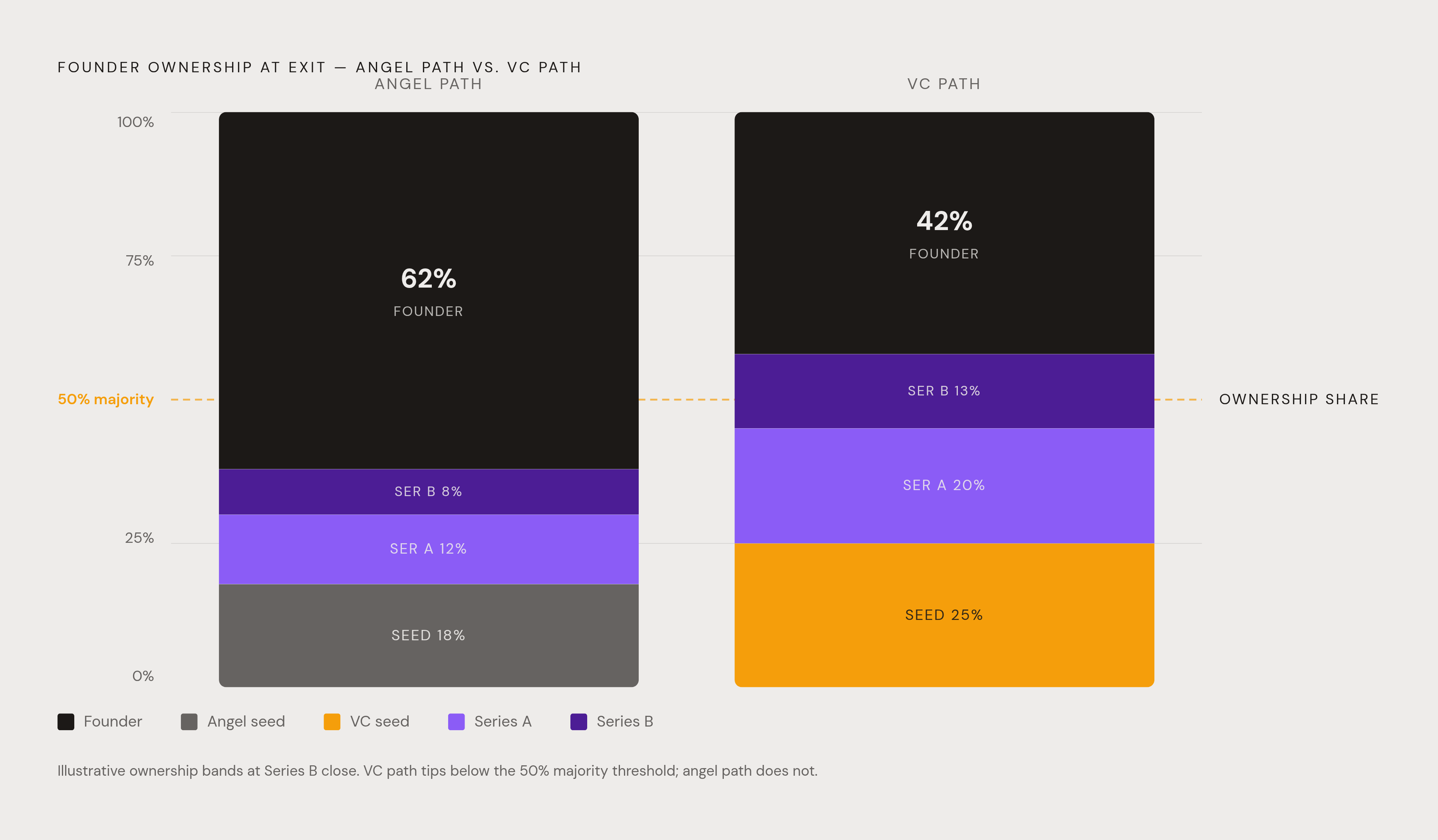
Start with dilution. Angels, collectively, tend to take somewhere in the range of 10% to 25% of a company in a seed round. VCs typically take a meaningfully larger share per round, reflecting both the size of the check and the return model behind it. Run that forward: by Series C, a company that has raised three successive VC rounds may find that VCs collectively own a majority of the business. A company that built its early capital stack primarily through angel money, by contrast, often holds onto substantially more ownership all the way through to an exit. None of this is an argument against raising from VCs. It's an argument for modeling the full path before choosing a lane, rather than optimizing only for the round directly in front of a founder right now.
The most counterintuitive part of this compounding appears in SAFE stacking. Post-money SAFEs have replaced convertible notes as the dominant instrument for pre-seed deals in 2026, representing the large majority of new deals at that stage, and for good reason: they're faster and cheaper to execute than a priced round or a note with interest and maturity terms attached. But speed and simplicity at signing can hide a dilution problem that only becomes visible at Series A. Stacking several SAFEs with different valuation caps across different closes can leave a founder having promised away more of the company than any single document made obvious at the time. Understanding how those caps convert, and what happens when multiple SAFEs convert into the same priced round, matters more before signing than after.
Governance compounds on its own separate timeline. During the SAFE or convertible-note window, co-founders remain the only directors, and operating freedom is at its highest point in the company's life. The moment a VC round prices, that changes immediately: a board seat gets filled, approval rights kick in over decisions that used to be made informally between co-founders, and a monthly reporting cadence becomes a fixed obligation. Experienced board advisors tend to share one piece of operating advice here: don't give away board seats easily, especially to angels writing comparatively small checks. An observer seat preserves far more flexibility, and it keeps the door open for whichever institutional lead eventually sets the board's composition at a priced round.
A growth-clock problem, which has gotten worse in recent years, drives both of these. VC capital comes bundled with implicit, and often explicit, expectations about growth pace, because institutional funds have their own return horizons and portfolio-pacing requirements that create pressure independent of what the business itself actually needs at that moment. Angel capital, especially from sources that haven't organized into a syndicate, tends to give founders more room to iterate and prove the model before any clock starts running. But that room can turn into a liability fast if runway gets miscalculated. The median gap between seed and Series A has stretched to 24 months, up from 18 months in 2021, and that longer gap puts more pressure on runway planning and punishes founders who leaned on angel capital without a clear bridge strategy in place for the stretch in between. The shift toward syndicated capital and SPV structures has made this planning problem sharper: a founder now needs real-time visibility into which angels are still writing solo checks, which have organized into institutional-grade syndicates, and which VCs are actively competing for the same seed allocations, and AI-driven platforms exist to surface that kind of market-structure intelligence in a market that has split as decisively as this one has.
Matching your capital source to your company's stage and trajectory
Choosing the right capital source comes down to three things: how much evidence the company has already built, what sector it operates in, and how large a check its next milestone actually requires. It has nothing to do with which investor happens to be easiest to reach or carries the most name recognition at a dinner party.
Angel capital, including organized syndicates, tends to fit best for a company that is pre-revenue or just starting to generate early revenue, still working to establish proof of product-market fit rather than scale. It fits when the target raise sits below a threshold where VC-level governance overhead would actually slow the business down, and where the goal is a specific, near-term milestone: a product launch, the first handful of paying customers, early recurring revenue. It fits when a founder needs the freedom to change pricing, pivot a feature set, or test a different version of the business model without running every decision through a board approval cycle first. And it fits particularly well in sectors like SaaS, consumer, fintech, or healthtech, where an executive syndicate built from operators in that exact domain can bring implementation knowledge that a generalist fund simply can't match.
Institutional VC capital fits a different set of conditions. It makes sense once the target round size requires a check larger than what angels, even organized into a syndicate, can efficiently provide. It makes sense in sectors like AI infrastructure or deeptech, where the pace of capital deployment demands institutional follow-on almost by default, and where the eventual Series A will itself be large enough that only a fund with real reserves can lead it. And it makes sense once a founder is genuinely ready to operate under formal governance, treating a board as a resource for hard decisions rather than an obstacle to route around.
The 2026 standard increasingly favors a hybrid architecture over a binary choice between these two paths, where a founder thinks about which slot each investor type is actually filling in the round, rather than picking one camp and ruling out the other. Y Combinator's own ecosystem shows how fast the calculus can shift once a company proves itself: the most in-demand companies in a given batch raise on SAFEs with very high valuation caps, or skip straight to a priced seed round, because the premium the market assigns to a standout batch company changes which investors are even realistically in reach. Ploy, a YC Spring 2026 company, announced a $27 million seed round led by First Round and Y Combinator, a scale that institutional capital alone can support and that no angel network, however well organized, could realistically assemble. Demo Day, in that light, is the start of a longer process that rewards founders who've already done the work of matching their capital source to the stage of evidence they've actually earned.