Why a Spreadsheet Fails as a Fundraising CRM
Stale data silently corrupts the pipeline picture founders depend on most.
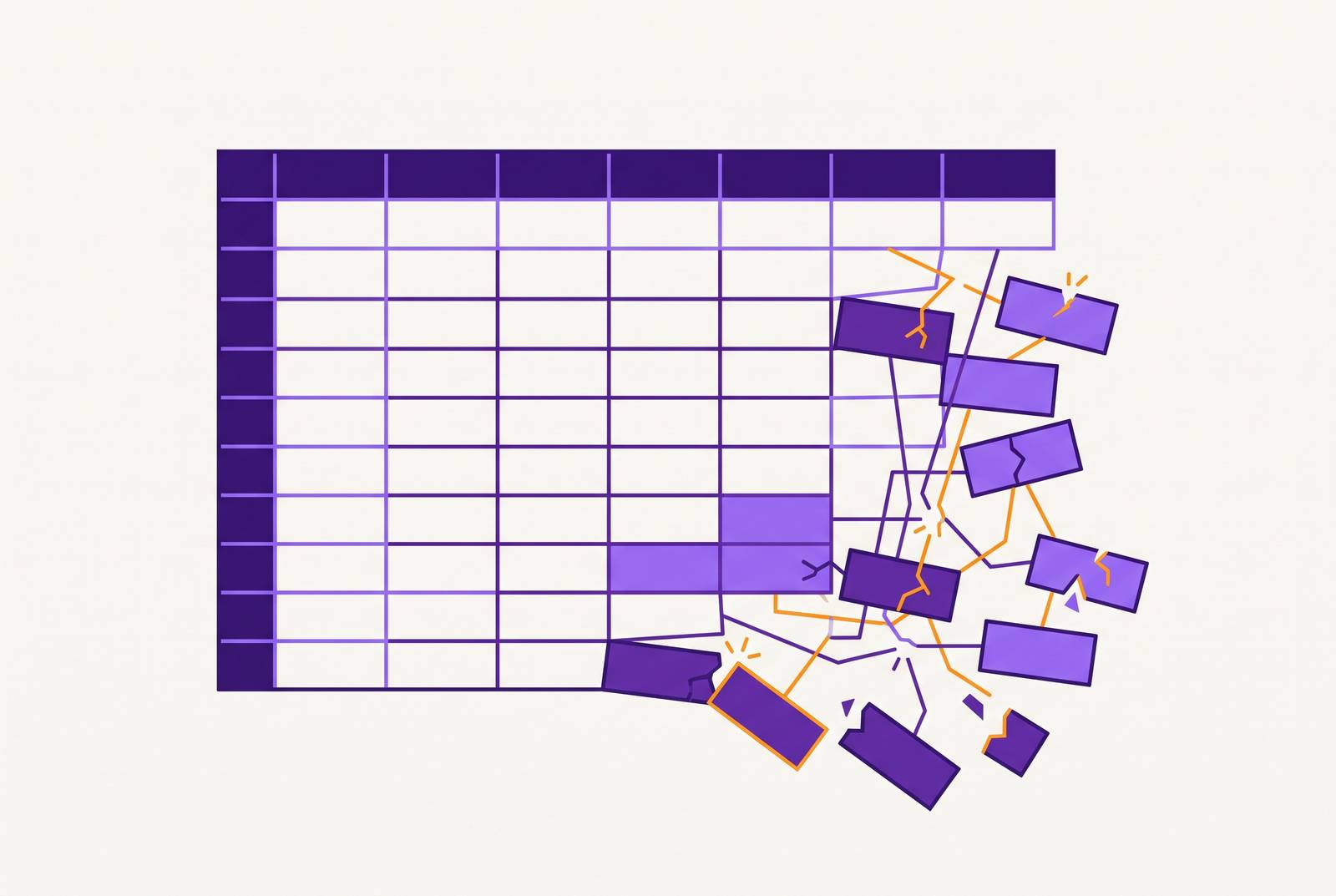
Stale pipeline stages that corrupt the picture founders rely on
A spreadsheet fails as a fundraising CRM in four specific, predictable ways: stale pipeline stages, missed follow-ups, lost context, and no engagement signal. Those four cracks widen at different speeds, and they start feeding each other long before anyone notices the raise has stalled. A tool that works fine for ten investors breaks somewhere well before fifty, and it breaks quietly. That's the real danger.
Starting with a spreadsheet is the rational move. It costs nothing, opens in five seconds, and every founder already knows how to use it. For the first fifteen or twenty conversations, a sheet with columns for name, firm, stage, and last contact does everything a founder needs it to do. The tool isn't the issue at that scale. The trouble starts once the pipeline outgrows what a grid of cells can hold.
Visible's data puts the average active fundraising pipeline at 52 investors, and half of active founders manage pipelines larger than that. Fifty-two rows means 52 research profiles, 52 first-meeting chases, 52 follow-up sequences, and 52 separate sets of notes on thesis fit, partner dynamics, and term preferences, all needing to stay current at the same time. A spreadsheet stops working well before it hits that mark: warm introductions slip through unnoticed, follow-up timing drifts, and momentum bleeds out quietly once active relationships cross the threshold a spreadsheet can realistically track, before the founder running the raise has any sign something is wrong.
Every stage in a spreadsheet is a manual entry, current only as of the last time someone remembered to update it. At ten relationships, that's a minor inconvenience. At 30 or more, the gap between what the sheet says and what's actually happening in the raise widens every day, and nobody is tracking the widening because nobody is looking for it.
Authencio's case work on spreadsheet-based financial tracking offers a useful mechanism here: a team member sorts a single column without sorting the rest, and a $50,000 enterprise pilot ends up attached to the wrong contact entirely, while the "Probability Weighted Revenue" total silently drops. Nobody touched the number on purpose. The structure just broke, quietly, and the sheet kept looking authoritative right up until someone pulled it for a deck and the math didn't add up.
The same mechanism plays out on a cap table raise. A relationship logged as "in diligence" might be stone cold. An investor marked "passed" might be getting re-approached right now by a co-founder who never saw the note. A spreadsheet can't tell a true stage from a stale one: no timestamp forces a refresh, no audit trail shows who touched what, and nothing flags a row that hasn't moved in two weeks despite an active thread sitting in someone's inbox. The sheet ends up a lagging indicator dressed as a live dashboard, and founders sequence outreach off information that's already gone stale by the time they read it.
Follow-up timing causes warm introductions to go cold.
Fundraises are not won on one great pitch. Investors commit after weeks of consistent updates, momentum signals, and follow-ups timed to land when a partner is actually paying attention, not after a single strong meeting that never gets reinforced. Most founders plan for one or two touchpoints per investor. The real number runs several times higher before anyone lands on a clear yes or no.
A note to "reconnect in Q2" gets buried in a thread and never resurfaces. Two of the highest-conviction investors in the pipeline go quiet because nobody followed up at the moment their interest peaked. A partner asks for a deck that already went out three weeks earlier, and with no record of that exchange, the ask lands as a fresh request instead of a nudge.
At the 30-investor mark, this turns messier still, the pattern is consistent across pipeline management failures: a warm intro goes cold from plain neglect, two team members send the same investor the same deck on the same day, or a partner meeting gets booked without anyone checking when that thread last moved. A spreadsheet has no reminder engine built in, no sequencing logic, and no way to flag a thread that has gone quiet. Silence and "in progress" look identical on the page, and that is the failure that costs the most. One missed warm intro can cost the entire branching path it would have opened, at the exact stage in a raise when one lead investor's conviction tends to pull others in behind it.
Lost context and the coordination breakdown across co-founders and advisors
Investor context in a real raise lives across the shared sheet, the founder's inbox, and the founder's memory. None of those three are the same document, and none of them reliably talk to each other.
Context, in fundraising terms, means specific things: the thesis note from the first call, a partner's one lingering concern from meeting two, whether the updated-financials version of the deck actually went out, and who on the cap table has a real relationship with this fund already. A spreadsheet row can't hold a conversation. It holds whatever someone typed into a cell after the conversation ended, and more often than not, that's nothing.
The coordination failures that follow are mundane and constant. A co-founder overwrites a row an advisor is mid-edit on. Notes from a partner call live in someone's personal notes app and never make it into the shared file. A new advisor joins the raise midstream with zero visibility into who's been talked to, what's been promised, or what's already dead.
Generic sales CRMs don't fix any of this. Gritt.io reports that they lack the specific machinery to manage investor pipelines, enrich contacts with investment history, or report raise progress back to co-founders and advisors in a format that means anything to them. The raise ends up running inside individual people's heads instead of inside one shared system, and every handoff between people becomes a place where information quietly drops.
The engagement signal gap, operating without knowing who is interested
A spreadsheet records what a founder did. It has no way to record what an investor did in response, and that asymmetry is where a lot of raises quietly lose their footing.
Whether a deck got opened, how many times, which slides held attention longest, whether a data room link got clicked, whether an investor update actually got read past the subject line: these are the signals that matter here, and a spreadsheet captures none of them. A genuine investor CRM handles five things a sales CRM was never built for, per Visible: fundraising-specific pipeline stages, native investor updates, a permissioned data room, deck-level engagement tracking, and a connected metrics dashboard, all inside one system instead of stitched together across five tools.
Without that signal layer, a founder cannot tell a quietly excited investor from a quietly gone one. Both appear in the spreadsheet as "awaiting reply," which says nothing about where to spend the next hour of outreach. Push harder where interest appears in the data, and give space where it doesn't. Without the data, founders guess on the highest-stakes sequencing calls of the entire raise, deciding who to push, who to leave alone, and who needs a different angle, based on nothing but instinct.
These failure modes compound, and founders notice too late.
None of these four failure modes sits in isolation. They feed each other, and that compounding is the real threat, not any one crack on its own. Stale stages mean follow-up timing gets calibrated against information that's already wrong. Lost context means the follow-ups that do go out read as generic rather than specific to that relationship. And with no engagement signal, a founder can't tell whether a stalled stage means investor hesitation or founder neglect, since both produce the exact same blank row.
A raise that reads as "on track" inside the spreadsheet can be leaking momentum from three or four points at once, and the sheet has no way to surface that, because the sheet itself is part of what's causing it.
Founders notice late for a specific reason: a spreadsheet gives the visual impression of control, rows, columns, stages, a list that looks complete. That appearance masks the absence of any real-time signal, since the spreadsheet has no mechanism for capturing engagement as it happens. By the time the stall becomes visible, several high-conviction relationships have already gone cold, the raise window has narrowed, and re-engaging from a position of lost momentum is structurally harder than simply maintaining it would have been.
The market makes this less forgiving than it used to be. In 2026's environment, investors who fit a company's thesis tightly tend to move fast, and at higher valuations, for the deals that clear their bar. A missed follow-up window at the wrong moment doesn't get recovered later the way it might have in a slower, more permissive funding cycle.
What a purpose-built investor CRM does that a spreadsheet structurally cannot
The gap between a sales CRM and an investor CRM isn't a matter of branding or a few extra features bolted on. The underlying workflow assumptions differ from the ground up. A sales CRM optimizes for deal velocity, volume, and conversion funnels, moving as many transactions through a pipe as fast as possible. A fundraise is a small number of high-stakes, long-cycle relationships, where a single conversation can outweigh a hundred cold outreach touches, and treating the two the same is the mistake most founders make by default, simply because a sales CRM is the tool already sitting on the shelf.
Visible holds that a genuine investor CRM tracks pipeline by fundraising-specific stage rather than sales stage, manages follow-ups so a warm intro doesn't fall through, centralizes conversations and documents across co-founders and advisors in one place, monitors engagement signals so outreach prioritizes itself instead of running on guesswork, sends investor updates from inside the same system, and gives the founding team a shared view of who owns which relationship.
Beyond those baseline functions, the tooling closes gaps already named above. Warm introduction mapping runs automated analysis across a founder's network, surfacing intro paths through advisors, existing backers, and customers that a spreadsheet would never reveal on its own. Round context sits directly on each investor's card: how much is being raised, at what valuation, how much is already soft-circled, none of which a spreadsheet carries natively. Portfolio conflict flags catch it early when a fund already owns a competitor, saving weeks that would otherwise go to a dead-end conversation. AI-guided investor search filters by thesis fit, portfolio overlap, stage, and check size, surfacing investors who actually fit instead of encouraging a spray-and-pray approach that burns time on volume over fit.
Investors have long operated with proprietary data on founders, rounds, and market signals that founders themselves rarely see, and that asymmetry is structural. A founder running a raise off a spreadsheet negotiates from an information disadvantage against counterparties who don't share that problem. Purpose-built tooling doesn't erase the gap, but it closes a meaningful piece of it. Fundraising is its own operational discipline, with its own cadence, stakes, and failure points, and the tools supporting it should be built for that discipline rather than borrowed wholesale from adjacent sales workflows.
Evaluating the right tool for your raise stage and pipeline size
Stage and pipeline size should drive this decision, not feature counts or brand reputation.
For a pre-seed or first raise with fewer than 20 active relationships, cost and simplicity win outright, and a spreadsheet is the right call here, full stop. A lighter tool keeps friction low without over-engineering a process the founder is still learning firsthand. Once a raise hits seed or Series A territory, with active relationships in the range where spreadsheets are known to break down, the failure modes covered above stop being theoretical and start being live. At that scale, the cost of dropped relationships outweighs whatever a purpose-built tool costs to run, and clinging to a spreadsheet past this point is a false economy dressed up as thrift.
Team dynamics matter as much as headcount. Any raise involving co-founders and advisors working the list together needs shared visibility into who owns which relationship and shared access to notes, and a spreadsheet breaks down here regardless of how many investors are actually in it.
Round intelligence, including valuation context, soft-circle tracking, and portfolio conflict detection, requires information a spreadsheet was never built to hold, and no amount of clever formatting fixes that.
The round doesn't end at the term sheet, either. Visible finds that the right tool carries investor relations forward after close, keeping the same contacts, dashboards, and update cadence running into the next round instead of forcing a founder to rebuild the whole system from scratch each time they raise. The longest feature list isn't the question that matters. What matters is which tool removes the specific failure modes most likely to stall this particular raise, at this particular stage, with this particular pipeline.