What Operational Readiness for a Series A Actually Looks Like
Series A now demands a working business, not just a promising idea.
Series A used to reward a good story. Now it rewards a business that already runs. Waveup's survey of 52 Series A funds shows B2B SaaS companies now close at a median of $3M ARR, a threshold that would have looked absurd to a 2021 investor writing checks against pilots and pitch decks. Round volume has followed the same contraction: PitchBook counts roughly 4,200 US Series A closes at the 2021 peak, down to around 2,800 in 2025, with Q1 2025 logging just 1,122, the lowest count since 2018. What changed is the definition of proof, and most founders raising this year are still operating off the old one.
What investors are buying at Series A, and how that shapes every readiness signal
Seed investors fund founders. Series A investors fund businesses. That distinction sounds like a platitude until you trace what it does to the evaluation itself. A seed check bets on a person's judgment and a hypothesis worth testing. A Series A check bets on a system that has already been tested and now needs fuel to run faster.
Waveup frames the round as capital to scale a go-to-market motion that's already codified and measurable, not to fund the search for one. Finta sharpens this further: the capital should finance a specific change in the company's risk profile, converting product-market fit into a growth system rather than underwriting more discovery. Investors are asking whether the machinery around the product can scale without the founders personally closing every deal, fixing every churn risk, and hand-holding every enterprise contract to signature, not merely whether the product works. They're asking whether the machinery around it can scale without the founders personally closing every deal, fixing every churn risk, and hand-holding every enterprise contract to signature.
Every metric a Series A fund requests, from cohort retention to CAC payback, functions as a proxy for one question: is the machine built, or is it still the founders wearing every hat? Founder-dependent sales and distribution is the single clearest tell that a company has a product with fans but not a business with a repeatable engine. Investors have seen this pattern enough times that they can spot it inside one call: ask a founder to walk through the last five closed deals, and if the founder was personally on all five, the growth story stops being about the product.
The revenue and retention thresholds investors use as a first filter
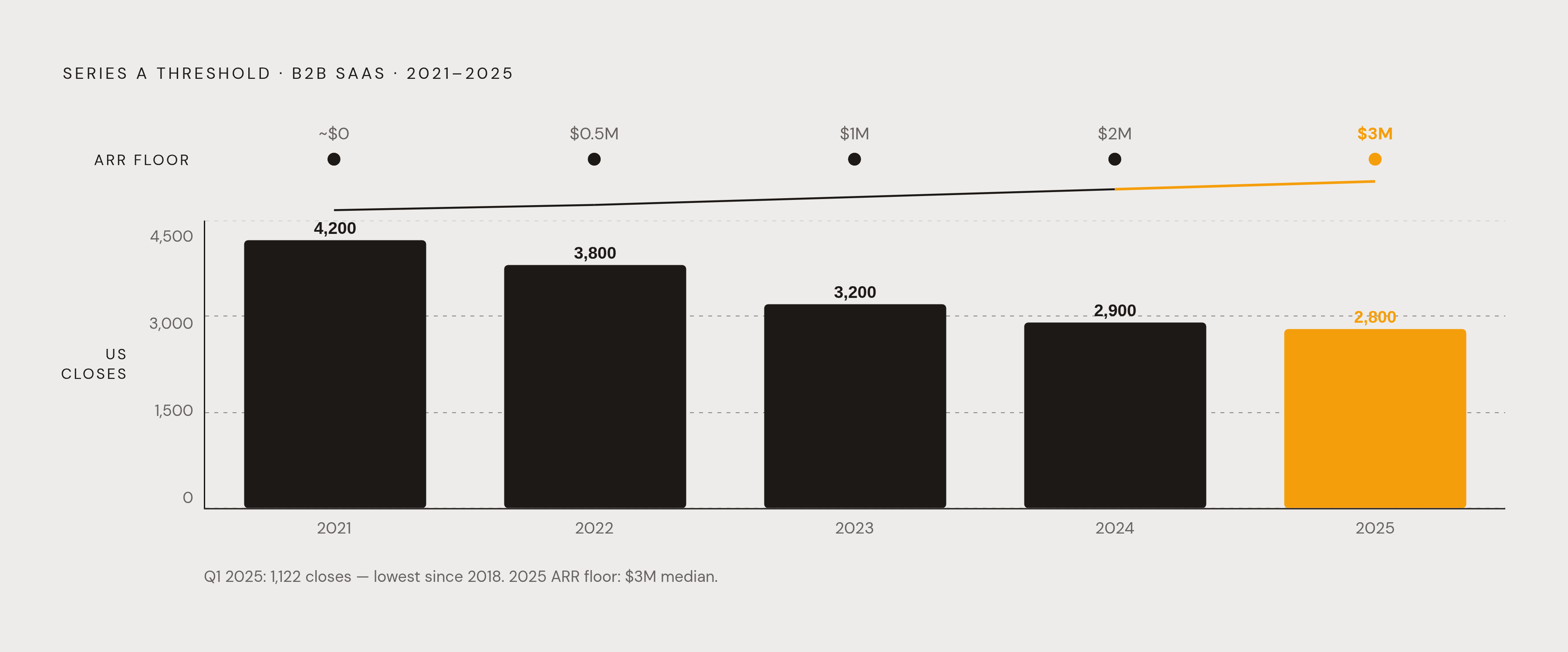
$1M ARR used to mean something at Series A. It reads as a seed-stage number now. The floor is around $2M, with a Waveup survey of 52 Series A funds placing the median at $3M.
Growth rate complicates any urge to treat that figure as a hard line, and it should. A company with strong growth momentum can generate more investor interest than one with higher ARR but decelerating, because Series A prices a trajectory, not a balance sheet on a given Tuesday. The median 2026 Series A company grows 2x to 3x year-over-year, and that rate is what gives the ARR floor its meaning. A $3M ARR business growing 15% a year is a different diligence conversation than one growing three times as fast, even with identical revenue on the page.
Retention carries at least equal weight. Net revenue retention above 120% is the benchmark investors prioritize, and it proves something growth alone can't: that the existing customer base expands on its own, without new logo acquisition doing all the work. Churn is the harder gate. Monthly churn above 5% for B2B companies signals a real PMF problem, and annual churn above 20% makes a Series A close nearly impossible, regardless of how the growth chart looks.
None of it holds up without paying customers behind it. Twelve or more months of actual revenue data is the minimum evidence base investors accept, and per Qubit Capital, pilots, letters of intent, and design partner agreements at zero revenue don't count as proof of anything except interest. Different business models and go-to-market motions run on different capital efficiency curves, and the right benchmark depends on which category a company actually belongs to. Quoting a single ARR number as gospel is more likely to mislead a founder than help one, and founders who fixate on hitting $3M exactly while ignoring their growth rate are optimizing the wrong variable.
Unit economics and efficiency benchmarks investors stress-test in diligence
LTV to CAC of 3:1 is the floor. A ratio sitting right at 3:1 reads as adequate, not exceptional, and companies commanding premium valuations right now clear it by a wide margin.
Gross margin benchmarks vary by business model in ways generic fundraising advice tends to flatten. Pure software businesses are expected to clear 70%, a number echoed by Waveup's fund survey. Hardware runs on different physics: 40% to 50% gross margin at volume production is the realistic target, and investors underwrite the path to that margin rather than penalize a company for not already being there. AI products sit in their own category, with lower margins expected structurally, since inference cost is a real, unavoidable line in cost of goods sold. What matters for an AI company isn't the current margin figure but its direction: What matters for an AI company is the direction of margin improvement, and a company trending upward tells a different story than one stuck at a low figure with no plan to close the gap.
Burn multiple, the ratio of burn to net new ARR generated, should ideally sit under 1x at this stage. Strong revenue per employee is a marker of real operational efficiency at this stage, and Short CAC payback periods appear among companies raising at premium valuations, though that's a mark of exceptional performance, not a floor every company has to clear for a term sheet.
None of these numbers mean much in isolation. Diligence actually probes whether founders understand why their numbers look the way they do, can explain the exceptions with cohort-level data, and aren't leaning on a spreadsheet projection to cover a gap in actuals. The principle is straightforward: projections don't survive diligence. Only realized numbers do.
This is where thin AI wrapper companies get exposed fastest. Investors have gotten fast at telling a genuine, defensible data advantage apart from an interface layer sitting on top of a foundation model API, and the pattern is consistent enough that thin wrapper companies without a real data moat are broadly seen as high-failure-rate investments. That category doesn't get a discount at Series A. It gets excluded from the process before terms are even discussed.
A repeatable go-to-market motion, as an investor evaluates it
"We closed several deals" doesn't answer how a company finds and wins customers. "Here's the process that recurs, and here's exactly which parts still depend on the founders personally," does. That's the bar Waveup describes, and it's narrower than most founders assume walking in.
Finta breaks the GTM story into pieces an investor expects answered in sequence, covering the initial ideal customer profile, the buying event that triggers a purchase decision, who the actual decision-maker is, the sales or adoption motion itself, time to value, the expansion path once a customer is in, and the bottleneck new capital is specifically meant to remove. That last piece gets skipped constantly in pitch decks, and its absence is conspicuous to anyone running diligence for a living.
At least one repeatable acquisition channel, at a predictable cost, is a readiness condition per Rho. Not a one-off PR hit, not a viral tweet, not the founder's personal network exhausted in a single quarter. A process that runs again next month with roughly the same inputs and outputs.
Team structure tells its own story here. Qubit Capital identifies a VP of Sales or Head of Growth who has already closed real deals in seat as a condition to walk into the room with. Finta flags that hiring a sales leader before positioning, pricing, and a repeatable customer segment are actually understood adds cost without adding learning, and getting the sequence of hires wrong above 10 headcount slows learning more than the headcount total itself does. Every executive hire on the roadmap should map to a specific metric and a specific decision date, not sit on a wish list attached to a hiring plan slide.
Founder-dependent distribution remains the most common disqualifier in this whole framework, and it recurs across nearly every diligence conversation at this stage. If the founders are the sales engine, the business hasn't proven it can scale past them, no matter how good the numbers look this quarter.
The data room and financial model investors expect before diligence begins
Finta's list of required materials is long, and every item on it exists because some fund, at some point, got burned by its absence: monthly historical financials, a board-quality operating model, customer or user cohort data, revenue concentration figures, pipeline conversion rates by stage, churn analysis, gross-margin bridges, hiring history, a product roadmap, security and compliance documentation, and a cap table that reconciles cleanly to every signed legal document.
The financial model is where most companies quietly fail before a partner meeting even happens. Waveup finds that 80% of models reviewed in diligence don't clearly show the cash gap the raise is meant to fill. A model showing a company comfortably approaching profitability while the deck asks for $10M anyway is a modeling error. It's a modeling error, and it reads as one immediately to anyone who's built one of these models before.
Round sizing follows its own logic: raise enough to hit clear Series B milestones, typically 18 to 24 months of runway with a buffer built in, though Waveup notes some funds now push founders toward 36 months given how long the market has stretched. Founders who set 18-month runway targets off a seed round can run out of cash six months short of the ARR threshold that would have opened Series A doors, leaving no buffer for a slower market. That gap stays silent right up until it isn't.
Exceptions need explaining before an investor finds them unexplained. Finta advises that if a single customer accounts for an outsized share of revenue, the data room needs contract terms, usage trends, renewal risk, and a diversification plan sitting right next to that number. If one cohort underperformed relative to the others, the room needs to show what changed and what was learned.
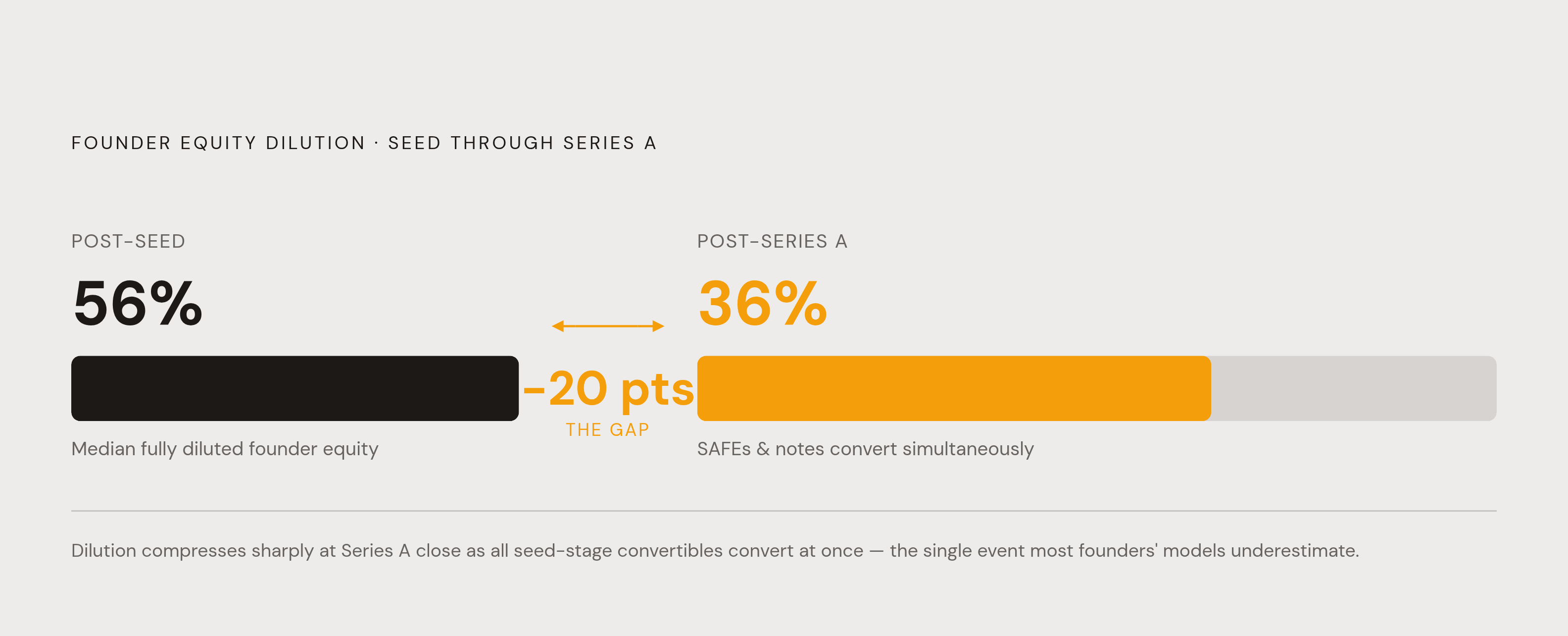
Cap table complexity deserves its own scrutiny, since it's where founder expectations and reality diverge most. SAFEs and convertible notes from the seed round convert simultaneously at Series A, and founders need to model cumulative dilution across every prior instrument before walking into a term sheet negotiation, not after. Qubit Capital puts the median founding team's fully diluted equity at roughly 56% right after seed, a number that drops to roughly 36% once Series A actually closes. A founder's mental model, built off a single funding round, commonly misses that cumulative outcome by twenty points of equity, a gap that becomes visible mid-diligence and is entirely avoidable with modeling done early.
Companies outside software need a different data room built around different evidence. Finta holds that the room should reflect what actually drives value in that business: technical validation, clinical trial data, manufacturing yield, regulatory milestones, or transaction volume, built around the evidence that specific business runs on rather than a SaaS metrics template.
How investor relationship timing affects whether a process closes
The cold pitch is dying as a path to a term sheet. Waveup finds that two out of three Series A deals now involve an investor who already knew the founder for six to nine months, or longer, before the round closed.
That tracks with how venture funds source deals in the first place: a large share of VC investment activity is outbound. By the time a founder formally announces they're raising, the investor across the table has usually already made a quiet decision that places that founder on the list or off it. The mechanism is described as "lines, not dots": starting the relationship six to twelve months before any ask is made, sharing real progress on a quarterly cadence, with no pitch attached. Conviction builds over that stretch. It rarely builds inside a single 45-minute meeting, however sharp the deck.
The overall timeline has stretched to match. Median time from seed to Series A is 616 days as of 2025, and 39% of companies that closed a Series A in Q3 2025 took three years or longer to get there. That stretch is the actual window in which the investor relationship gets built, quarter by quarter, long before a pitch deck exists.
The formal process itself, once a company is genuinely ready, can move fast: the formal close can move relatively quickly for a team with the evidence already assembled. Getting to that point of readiness is what takes a year or two after seed for most teams. Maintaining real business momentum while running that process, instead of letting growth stall because the founders are stuck in investor meetings all quarter, gets read as its own signal of operational maturity. Calendar timing matters at the margins too: Q4 closes roughly 20% more Series A deals than Q1, though that seasonal pattern is a minor lever next to the relationship runway itself.
Assessing your own readiness before entering the process
Investors stress-test five areas in diligence: revenue and retention, unit economics, GTM repeatability, data room quality, and relationship runway. Every one of those is testable by a founder, alone, before a single meeting gets booked.
On revenue and retention: is ARR at $2M or above, with 2x to 3x year-over-year growth behind it? Is net revenue retention above 120%? Is there 12 or more months of actual paying customer cohort data, not pilots, not LOIs, not design partner agreements with no invoice attached?
On unit economics: is LTV to CAC at 3:1 or better, backed by realized actuals rather than a projection built in a spreadsheet last week? Is gross margin at or above 70% for a software business, or, for hardware and AI, is there a specific, credible structural path toward margin rather than a hope? Is burn multiple under 1x?
On GTM repeatability: can the founders describe, in specific process terms, a sales motion that runs without their direct involvement in every deal? Is there at least one acquisition channel with documented, repeatable performance? Is a sales or growth leader already in seat, already closing real deals, rather than a headcount line on a post-raise hiring plan?
On the data room: are monthly historical financials clean and reconciled, sitting alongside a board-quality operating model? Has the cap table been modeled all the way through SAFE and note conversion, so founders know their actual post-Series A ownership instead of an estimate from a single-round cap table tool? Can every likely exception, a concentrated customer, an underperforming cohort, a margin anomaly, be explained with data before an investor stumbles onto it first?
On relationship runway: is there an actual list of target investors who already know the company's trajectory, built over quarters, or is the plan to cold-pitch a list scraped together the week the raise starts? Is the raise being planned with enough runway to run a real three to six month process, ideally from a position of 24 or more months of capital still in the bank?
Founders who run this test honestly will sometimes land on an answer they don't want: six to twelve months short of ready. That's useful information, not a bad outcome, and the right response is using that window to build the missing evidence, not entering a process early and absorbing punitive dilution or, worse, a failed raise that becomes its own signal to the next set of investors. Fundraising at this stage behaves like any other structured process. It gets prepared for, sequenced, and run with discipline, and the founders who close Series A rounds this year aren't the ones with the warmest introductions. They're the ones who walked in with the evidence already sitting in the data room, waiting to be checked.