Investor Pipeline CRM Setup for Early-Stage Founders
Weak pipeline discipline costs founders more in a competitive market than poor targeting ever did.
A founder sends a warm intro request to a fund partner, gets a reply within the day, and then loses the thread. No one on the founding team follows up, because no one owned the relationship and no date was ever set for the next move. That single dropped thread is the entire failure mode of spreadsheet fundraising, repeated dozens of times across a raise. The list doesn't get too long to manage. Relationships sit with no stage, no owner, and no next action attached, so warm momentum drains out quietly while the founder is busy elsewhere.
At scale, the pattern compounds fast. Visible's fundraising data puts the average active pipeline at 52 investors, with half of all founders managing more than that, a volume at which manual tracking reliably produces missed follow-ups, cold warm intros, and a pipeline the founder can no longer read clearly enough to prioritize. Disorganization isn't the failure; invisibility is, since without stage data attached to each contact, no one can see which investors are warming up, which have gone quiet, and which need a nudge this week. A spreadsheet can hold names and dates just fine. What it can't do is force a founder to act on what those dates mean, and that gap is where rounds stall.
What the 2026 fundraising environment demands from pipeline discipline
The stakes on that gap have risen. The market in 2026 is bifurcated in ways that raise the operational bar considerably: capital is concentrating among a smaller set of funds and companies, timelines between rounds have stretched out, and founders outside the top tier need a more precise, disciplined raise process to compete, not simply more outreach volume. Throwing more names into the funnel no longer compensates for a process that leaks relationships along the way.
Visible's data and the broader market picture both point to a funnel that now requires founders to manage well over a hundred outreach targets at the top of the pipeline, while running a tightly sequenced follow-up discipline all the way through to close. Eighteen months ago, a clean kanban board with a few columns felt like enough for a seed round. It no longer does. Founders now need stage logic that reflects how venture conversations actually progress, reminder systems that fire before a relationship cools, and engagement signals that show where attention is landing in real time.
Part of what changed is how cheap outreach itself has become. AI-assisted tools have collapsed the time cost of writing a partner-specific email that once took real effort to draft well. That shift means the constraint has moved. Reaching investors is no longer the hard part of a raise. Whether the founder's system can absorb the resulting flow of replies, meetings, and diligence requests without letting any of them stall is the harder problem, and it is a pipeline-management problem before it is a tool problem.
The architecture that has to exist before any tool is chosen
None of this gets solved by picking software first. A CRM for fundraising is only as useful as the architecture loaded into it: the right stages, the right fields, and a shared agreement among the founding team about what actually moves an investor from one stage to the next. Without that agreement, any tool, purpose-built or repurposed from sales, becomes an expensive contact list. The tool stores data. The architecture decides whether that data means anything.
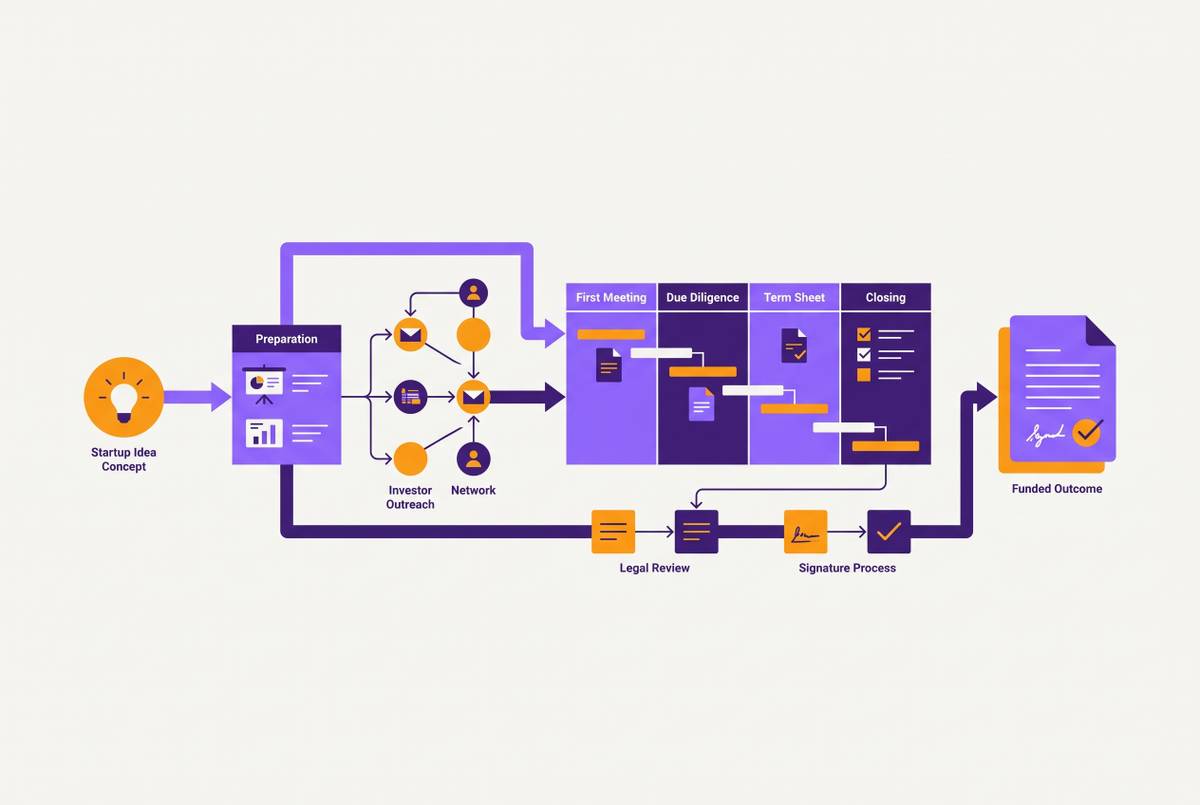
The stages that practitioners actually use, in sequence, look like this:
- Research: investor identified, fit not yet verified
- Intro requested: warm path identified or outreach initiated
- Contacted: first message sent, awaiting response
- Meeting: first call or partner meeting booked or completed
- Diligence: investor is actively reviewing materials
- Passed: explicit or implicit no, with a note on the reason
- Committed: verbal or written commitment received
- Update list: post-close relationship management
Each of those stages needs three fields attached at minimum: a named owner on the founding team who holds the relationship, a next action that is specific and dated, and a last-contact date. Without these three fields, the stages are just labels sitting on a record, not a system that tells anyone what to do next.
The passed stage deserves as much rigor as any active one. Logging why an investor passed, and when the conversation actually ended, builds a body of re-engagement data that matters for future rounds and for reading patterns across the whole funnel, since a fund that passed twice on valuation is a different signal than one that passed on stage fit. Skipping that note at the moment of the pass means losing information that only exists in that instant.
None of this architecture, though, fixes a bad list. A well-designed CRM will help a founder move faster in the wrong direction if the underlying investor list is weak to begin with. Architecture doesn't fix targeting; it only makes the consequences of bad targeting more visible, and faster to see.
How investor targeting precision shapes what enters the pipeline
It's to build a short list of investors whose stage focus, sector thesis, check size, and current portfolio activity all line up with the company raising. Outreach volume without that alignment produces low conversion at every single stage downstream, no matter how well the pipeline architecture handles it.
Warm introductions remain the highest-converting way into a pipeline. Portfolio founder introductions, angels who have already invested in the category, and well-networked advisors all outperform cold outreach by a wide margin, and the architecture has to distinguish these paths and track them separately rather than lumping every contact into one undifferentiated column.
Cold outreach hasn't disappeared as a viable path, though. In 2026, per-investor research, deck-thesis matching, and personalized outreach are all achievable quickly with AI-assisted tools. The practical effect is that cold outreach at pre-seed is no longer automatically the weaker option, so long as it's genuinely thesis-matched and personalized rather than broadcast to a purchased list. That distinction, matched versus broadcast, is the whole difference between a cold email that converts and one that gets deleted on sight.
What actually belongs in the research stage before an investor advances to intro requested comes down to a few checks. Stage fit needs confirming: the fund must be actively writing checks at this round size right now. Sector thesis needs verifying against recent portfolio activity, not just the language on the fund's website, since stated focus and current behavior often diverge. The fund's current cycle needs checking too: a fund in year seven of a ten-year cycle is less likely to be writing new checks than one earlier in that cycle. And a warm intro path needs mapping, identifying who in the founder's network connects to this investor and how strong that connection actually is.
Founders doing this research lean on a handful of named platforms built for exactly this layer. A range of platforms each cover different combinations of fund data, portfolio mapping, and contact enrichment. None of these tools replace the judgment call at the center of targeting.
Follow-up cadence as a pipeline discipline, not an afterthought
Once an investor is in the pipeline with the right stage and the right owner attached, the architecture still has to survive contact with time. Follow-up is systematically underexecuted. Most founders plan for one or two touchpoints per investor, when most relationships actually require several more before reaching a clear yes or a clean no. The gap between what founders plan for and what a round actually requires is where live deals quietly die, not in a dramatic rejection but in a slow fade nobody notices until the round is closing without that investor in it.
A structured cadence, anchored directly in the CRM record, closes that gap. On day zero, the introduction or first outreach goes out, and gets logged immediately with a next-action date set before the founder moves to the next contact. By day fourteen, the thread gets a final ask or a clear close, which sounds blunt but actually preserves the relationship for future rounds while freeing up pipeline capacity for contacts that are moving.
That cadence only functions if next-action dates are mandatory for every single record, not optional for the ones a founder feels less urgency about. A pipeline where some contacts carry no dated next action is a pipeline with leaks that stay invisible until the money's already gone quiet on the other end.
Engagement signals feed directly into that cadence and should reorder it constantly. A deck open, a data room view, an update open: none of these are vanity metrics sitting in an analytics dashboard for show. They're inputs that should re-rank follow-up priority in real time, so an investor who just opened the deck this morning moves to the top of this week's action list ahead of contacts who've gone silent for a month. A spreadsheet can't provide that re-ranking, so it's the bridge into the tool layer.
What purpose-built fundraising CRMs do that generic tools cannot
A generic sales CRM can be bent into something resembling a fundraising pipeline. Every bend, though, is a gap where work falls through. Stage labels built for a sales cycle don't map cleanly onto a venture round's actual shape. Engagement tracking built for bulk email campaigns doesn't surface the kind of per-investor deck signal that should be re-ranking a founder's follow-up list this week. And there's no native concept of a data room or an investor update sitting inside a tool designed to close enterprise software deals.
Visible identifies six jobs a real investor CRM needs to handle well: tracking the pipeline by fundraising stage, managing follow-ups and tasks, centralizing conversations across the founding team, monitoring investor engagement signals, sending investor updates, and coordinating team ownership of relationships. Most generic sales CRMs require heavy customization to cover even half of that list, and customization is time a founder mid-raise doesn't have to spend.
The market has split into two real camps in response, each carrying a genuine trade-off. Point solutions, tools built specifically for pipeline visibility, offer strong depth on the CRM side but stop at that boundary, leaving financial modeling, deck feedback, and coaching to live somewhere else entirely. Every one of those gaps is a place where work can fall through if a founder isn't deliberate about stitching the pieces together. All-in-one platforms take the opposite bet, trading some depth on any single feature for the fact that the whole raise sits in one place, which for a founder stretched thin across fundraising and running the company is often the deciding factor.
For a first-time founder building this out, the practical move is to start small rather than assembling a full stack before the process is even running. One tool for investor intelligence and pipeline tracking, one for deck feedback, and a clear owner assigned to each is enough to start. Complexity added before the raise is actually moving costs more than it saves.
How the tools that earned the most founder adoption in 2026 compare
Which tool fits comes down to stage, pipeline size, and whether a founder wants to assemble a stack or run everything through one system, not to feature count or name recognition.
Visible.vc, launched in 2014 and based in Chicago, is purpose-built for pre-seed through Series A founders. It ships with fundraising pipeline stages, a data room, investor update delivery, and engagement tracking all in one system, with a free tier for basic updates and paid plans priced accessibly. It added an investor discovery database and a HubSpot CRM sync in 2024. It fits well for founders running an active round with a substantial contact base, and fits less well for Series B and later founders managing formal institutional reporting.
Pipedrive, launched in 2010 in Tallinn, Estonia, received a majority investment from Vista Equity Partners in 2020. It runs a visual kanban pipeline with named ownership and next-action tracking built in, and released an AI deal-health assistant along with a native Campaigns module for sequenced outreach in 2023. It connects to more than 400 integrations, including Gmail, LinkedIn Sales Navigator, Slack, and DocuSign, with plans spread across several tiers billed annually and no minimum seat count. It suits pre-seed through Series B founders managing a wide set of investor conversations, and fits poorly for a founder with a very short list raising a single friends-and-family round.
Zoho CRM, launched in 2005 in Chennai, India, stayed bootstrapped with no outside capital and now serves organizations tracking relationships at scale across many use cases beyond fundraising. It expanded its Zia AI layer with deal-scoring, email sentiment analysis, and predictive lead-ranking in 2024, and links CRM pipeline data to finance and analytics through Zoho Analytics, a long-standing integration rather than a recent addition. It suits seed-to-growth-stage founders looking for investor contact management at a competitive per-user price.
HubSpot is a capable sales CRM that founders frequently adapt for fundraising use, but doing so requires heavy customization to replicate fundraising-specific workflows that the platform wasn't built around. Investor update delivery, a permissioned data room, and deck tracking all have to live in a separate stack alongside it.
Crunchbase, launched in 2007 in San Francisco, functions as a research and investor-discovery layer rather than a pipeline CRM in its own right. It fits best at the research stage, verifying fund activity, portfolio fit, and recent check-writing before an investor ever advances to outreach. The platform tracked tens of thousands of venture-backed rounds in 2025, covering more than 24,000 private companies funded that year, and pairs naturally with a dedicated CRM rather than replacing one.
Inpaceline combines pipeline tracking, runway modeling, and AI pitch deck analysis graded against a ten-slide framework, alongside an AI virtual C-suite layer, a CMO, CFO, and COO trained on startup best practices, for founders who want advisory input without a full advisor bench. It starts at a low monthly price with a seven-day free trial, and suits solo founders who want one system covering CRM, financial modeling, and deck feedback without stitching several tools together.
A founder-focused CRM built around solo pipeline tracking and investor relationship management is priced competitively on a monthly basis. It fits well for a founder running pipeline tracking alone, carries limited runway-modeling capability, and stops at the CRM boundary when it comes to coaching or pitch feedback, leaving that work to live elsewhere.
The comparison, in the end, only matters against the architecture built earlier: the stages, the mandatory fields, the targeting discipline, and the cadence. A tool that nails every feature on a marketing page but doesn't enforce a dated next action on every record will still let warm intros go cold. The stages and the discipline come first. The tool is just where they get enforced.