Term Sheet Negotiation Mechanics for First-Time Founders
How to avoid giving away control while chasing a high valuation.

Term sheet negotiation covers the headline valuation and the provisions that govern founder ownership, exit proceeds and control. For a first-time founder, the highest-leverage decision is understanding how those provisions work together before signing. A higher price cannot compensate for terms that divert the proceeds or give someone else the power to force the outcome.
Why a term sheet is a power structure, not a price tag
The PDF arrives, relief follows, and accepting can feel like the last step in fundraising. In practice, this is the highest-leverage negotiation a first-time founder will enter. Economic terms allocate ownership and proceeds through liquidation preference, anti-dilution and option pool sizing. Control terms allocate authority through board composition, protective provisions and drag-along rights. The valuation is only one part of that allocation.
Most of the document is non-binding, but exclusivity, confidentiality and sometimes expense reimbursement bind the founder on signing. That distinction does not make the remaining provisions easy to reopen. The definitive documents, usually based on NVCA model forms, follow most of what the term sheet says. Renegotiating later is costly and rare, so the practical deadline for resolving the business terms is before signature.
The valuation trap that catches first-time founders
Valuation gets attention because it seems to make offers easy to compare. The underlying arithmetic is straightforward. Pre-money valuation plus the amount of the investment is the post-money valuation. Investor ownership equals the investment divided by the post-money valuation. Confusing pre-money with post-money therefore changes the founder’s understanding of what is being sold.
A high pre-money valuation sets a bar the company must clear at its next financing or face a down round and the damage that can follow. An inflated pre-money option pool or aggressive investor rights can also make that offer worse than a lower valuation with clean terms. Price matters, but the real negotiation proceeds clause by clause.
How the option pool shuffle quietly lowers what founders receive
The option pool is an early test of whether the stated valuation reflects the equity founders retain. When the pool is created or expanded within the pre-money capitalization, its dilution falls on existing shareholders rather than being shared proportionally with the incoming investor. The headline price can stay the same while founders give up more ownership. With post-money pool treatment, all shareholders share that dilution, including the new investor.
HSBC Innovation Banking's Venture Term Sheet U.S. Financings Guide 2026, published in May 2026 and covering 500+ signed US deals, found that two thirds of rounds create or expand the employee pool. Frequency does not establish the right size for a particular company. The founder-friendly counter is post-money treatment or, at minimum, a pool sized to a realistic 12–18 month hiring plan. Tying the request to named hires replaces a percentage convention with a business requirement.
Liquidation preference: the clause that decides who gets paid in most exits
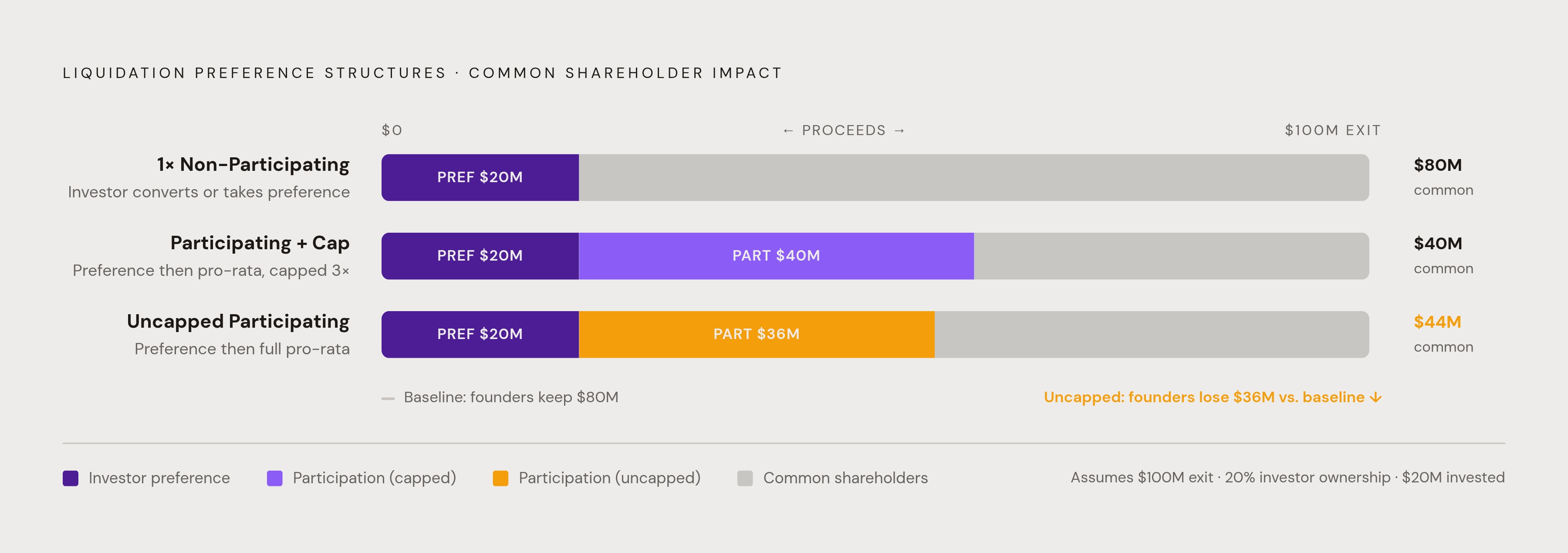
The pool determines how much equity founders retain, while liquidation preference determines what that equity receives in a sale or wind-down. In a mid-range acquisition, this clause can have a larger dollar impact than the valuation negotiation. The clean baseline is 1x non-participating preferred. The investor chooses between receiving its capital back under the preference and converting to common to share in the upside.
Participating preferred changes that bargain. The investor first takes its preference and then shares pro-rata in the remaining proceeds with common shareholders. At a modest exit, common therefore receives less than under non-participating preferred because investor capital comes out before the remaining proceeds are shared.
An elevated preference multiple compounds the effect and should be negotiated down. Uncapped participation is the most aggressive structure because it imposes no participation ceiling. If participation cannot be avoided, a cap is a meaningful compromise that limits participation to a set multiple of the investment, with conversion to common providing the route to further upside.
Anti-dilution provisions and what happens when the next round is a down round
Anti-dilution provisions carry the current negotiation into a future financing priced below this round. Broad-based weighted average adjusts the investor’s conversion price downward while accounting for the size of the new issuance. More shares issued at the lower price produce a larger, but still partial, adjustment. This is the market-standard structure.
Full ratchet instead resets the conversion price to the new lower price regardless of how many shares are sold. A single down-round share can trigger the full reset, giving the investor far more shares at founders’ and employees’ expense. The resulting cap table can also deter later investors. Standard carve-outs for capped employee option issuances, acquisitions and convertible instrument conversions should also be present.
Board composition and why the "independent director" framing is often misleading
Board control is where the economic rights already negotiated get enforced or traded away. The board can replace the CEO and approve or block acquisitions. A founder who wins on liquidation preference but loses board control has not won the negotiation. Economics and governance cannot be evaluated separately.
A typical seed board has two founder seats and one preferred investor seat. A common five-person Series A structure has two founder seats, two investor seats and one independent. How that last seat is filled determines who wins contested votes.
An independent director chosen unilaterally by the investor should be assumed to align with that investor on contested matters. The standard to seek is nomination by the full board and approval by both common and preferred shareholders. Language suggesting mutual consent is not enough if the investor effectively controls selection. Removal rights need equal scrutiny because unilateral preferred removal powers can undermine the protection suggested by the initial seat count.
Protective provisions and the veto rights that can paralyze a company
Board seats are only one dimension of control. Protective provisions give investors veto rights over certain company actions even when founders hold a board majority. Reasonable protections cover issuing new preferred stock, amending investor rights, liquidation or dissolution, and debt above a defined threshold. Consent rights can cause trouble when they reach into day-to-day operations or have no materiality thresholds.
Giving each preferred series its own approval rights can also lead to deadlock. Consider a small seed investor whose series can block a Series A financing that the founders and current lead both support. The voting structure gives the investor blocking power regardless of the size of its stake. Requiring preferred shareholders to vote as a single class addresses that fragmentation.
Operational vetoes over hiring above a salary threshold or ordinary-course contracts also warrant pushback. Standard financial reporting and inspection rights are different and are not worth the same negotiating effort. Attention belongs on consent rights that can stop the company from acting.
Drag-along provisions and the exit scenario founders don't see coming
A drag-along clause can turn investor control into a forced sale. The red-flag structure allows 50%+ of preferred, voting separately, to trigger a sale without common approval or a minimum price floor. Investors can then accept a price that covers their liquidation preference while leaving nothing for founders and employees.
The interaction with participating preferred is direct. If the sale proceeds are exhausted by the preference, common receives nothing, and there is no remaining pool in which to participate. If proceeds remain, participating investors also take their pro-rata share of that remainder. If common consent is not required, founders may have no way to block either outcome.
The protective structure requires a majority of the board, a majority of preferred and a majority of common to approve the drag-along. A price floor adds a condition that the sale price must exceed a threshold that guarantees common proceeds. These protections leave the distribution at the same sale price unchanged while preventing the drag-along from forcing that sale unless the agreed conditions are met.
Exclusivity windows and why signing the no-shop clause too early costs negotiating leverage
The no-shop clause binds on signing and removes competing investor interest as an active source of leverage. A credible competing term sheet gives founders an actual offer to compare on post-money pool treatment or cleaner governance. Signing exclusivity before those questions are settled surrenders that advantage.
The parties should therefore agree in principle on the key economic and governance terms before exclusivity begins. The window should run for a matter of weeks, long enough for diligence and documentation, with business negotiation already settled. Anything longer warrants pushback unless the deal is essentially done. Investor legal fee reimbursement should also be capped before signing.
How to build negotiating leverage before the term sheet arrives
Genuine investor competition comes from a structured, parallel fundraising process that brings interested parties forward at the same time. Sequential conversations rarely provide the same negotiating position. BATNA, the best alternative to a negotiated agreement, gives substance to the ability to decline. Without an alternative offer, rejecting aggressive terms is harder to make credible.
Preparation also requires separating non-negotiables from trade-offs. Board control, non-participating preference and post-money pool treatment belong in the first discussion, while pro-rata rights, information rights and specific consent thresholds are terms founders can trade. Without that distinction, founders can concede important rights merely to avoid friction. A clean data room supports the same discipline by shortening the path from term sheet to close.
Pushback should be calm and grounded in market structure. NVCA model documents and comparable recent deals provide anchors for explaining why a provision serves both parties. Investors also rely on market norms to syndicate deals with co-investors. The argument is strongest when it identifies a workable structure.
A stage-by-stage calibration: what to prioritize at pre-seed, seed, and Series A
At pre-seed, the priority is minimal governance and a simple cap table. SAFEs or convertible notes usually need only a few documents. A SAFE term sheet or side letter still needs a close look, especially when it adds pro-rata rights, information rights or board observer seats. The aim is to avoid building governance complexity before a seed lead sets the foundation.
At seed, that foundation becomes the main negotiation. Keep the two-founder-seat to one-investor-seat board structure, insist on non-participating preference, ask for post-money pool treatment and keep protective provisions standard. These terms will be inherited and expanded at Series A. Legal complexity is also a useful signal because fees well above the brief’s founder-friendly seed range of $10–20K can indicate a structure more complicated than necessary.
At Series A, the focus shifts toward the interaction among more formal governance rights. Common consent in the drag-along, preferred voting as a single class and a genuinely independent director nomination process become central. The greater number of provisions makes coherence more important.
What a genuinely founder-friendly term sheet looks like, and when to walk away
Founder-friendly protections address genuine investor risks without transferring disproportionate control or exit value. Clean economics have clear pre- and post-money valuations, a post-money or hiring-based option pool, 1x non-participating preference and broad-based weighted average anti-dilution. If participation is unavoidable, it is capped.
Clean governance preserves founder majority at seed and gives the full board the independent nomination right. Protective provisions cover only the standard actions, leave out operational vetoes and require preferred to vote as a single class. Drag-along requires board, preferred and common majorities, with a price floor. Exclusivity begins only after agreement on business terms, and legal reimbursement is capped at a stage-appropriate level.
Full ratchet is a reason to walk away, and when it comes with uncapped participation, investor-controlled drag-along without a floor or unilateral independent nomination, the trouble with the structure is even clearer. Any two of these provisions signal trouble that will carry into later stages. Deal momentum can obscure that judgment through time spent, relationship investment and fear of losing the offer. A term sheet built around multiple such provisions is not a bad deal to optimize, but a misaligned partnership to decline.