Seed Round Valuation and Dilution Benchmarks in 2025
AI deals skew seed benchmarks upward, leaving most founders overpriced.

A founder opens a benchmark report, finds the median seed post-money valuation, and treats it as a number worth matching in their own term sheet. The same year produced both record valuations and record-low Series A graduation rates, and if you don't understand why those two facts coexist, you'll misprice your round before a single investor meeting happens.
Why 2025 seed benchmarks mislead most founders
The blended median seed round and the blended median post-money valuation are both near all-time highs in 2025. Neither number describes a typical company. Both are pulled upward by a concentrated cluster of AI and deep-tech deals, the kind that raise at valuations unreachable for a SaaS company, a consumer app, or a services business with a conventional growth curve. Benchmark data puts the overall U.S. median seed round at a single headline figure, but that figure only holds together because a small number of outsized AI rounds drag the average far above where most real companies actually price. Founders who never check which deals built that figure still treat it as the default comp, even though it describes almost none of their actual experience.
That mismatch has consequences beyond an awkward investor conversation. A founder who anchors a non-AI round to the AI-inflated median is effectively asking a seed investor to price a conventional risk profile at an exceptional one. The investor either pushes back immediately, which costs time and credibility in a process where both are scarce, or the round closes anyway at a valuation the company's actual metrics will not support eighteen months later. That second outcome defers the reckoning to Series A, where the cost of the mistake compounds instead of resolving, which makes it worse than the first.
AI, Everyone Else, and Geography's Outsized Role
The seed market in 2025 functions as two markets operating under one label. One market prices AI and deep-tech companies against aggressive multiples, deep investor demand, and valuation ceilings that keep moving upward. The other prices everything else: enterprise software, consumer products, marketplaces, healthcare tools that aren't themselves AI-native, services businesses with software components. These two markets have different valuation norms, different investor pools, and different expectations for what a company needs to show at the next round. Treating them as one market, because the benchmark reports sometimes do, is where the mispricing starts.
Geography sharpens the split further. The Bay Area captured a dominant share of U.S. seed funding dollars in 2025, a share that grew sharply from prior years, even though roughly two-thirds of U.S. seed-stage startups by deal count are based elsewhere. Capital has concentrated geographically at the same moment that founder participation has spread out across more regions. The dollars and the deal count are moving in opposite directions. An enterprise SaaS founder building outside a top-tier market, pitching at a valuation calibrated to Bay Area AI norms, is asking investors to pay an AI-level price for a risk profile that isn't AI. The realistic clearing range for that deal sits meaningfully below the headline median, and no amount of founder conviction changes what the comp set will bear.
Non-AI founders shouldn't expect this gap to close in their favor, either. The practical takeaway isn't discouragement. It's calibration: know which of the two markets your company actually belongs to before you put a number on a term sheet, because the number that works in one market will misfire in the other.
The dilution math founders get wrong before the round even closes
Before a founder can set a defensible valuation, they need an accurate picture of what they'll actually own after the round closes, and that picture is usually worse than the headline terms suggest. The most commonly missed source of dilution is the option pool. Investors typically require a post-money option pool of 10 to 20 percent to be in place before their investment is counted, and that pool comes out of pre-money. A founder negotiating a post-money valuation with an option pool requirement near the higher end of that range is, in practical terms, negotiating around a sizable carve-out that reduces their own stake before a single dollar of new investor capital gets counted. Whether that pool comes from pre-money or post-money moves real percentage points of ownership, so it is a term worth negotiating explicitly.
SAFE stacking creates a second, quieter problem. It doesn't work that way. A priced structure simply doesn't have the conversion ambiguity that makes stacked SAFEs dangerous.
The trap of setting too high a seed valuation springs 18 months later
A seed valuation that feels like a win at signing can become the exact thing that blocks a Series A. The step-up ratio that growth-stage investors require before they'll commit capital drives the mechanism. Series A investors price companies on metrics, typically a meaningful ARR threshold paired with strong growth, not on what the company raised at seed. If the seed post-money already sits close to what those metrics would justify at Series A, the new round has nowhere to go: it prices flat, it prices down, or it doesn't close.
The step-up ratio itself is a useful diagnostic for founders setting seed terms. The median seed-to-Series A valuation step-up is recovering from its 2024 low but remains far below its earlier peak. Series A investors are demanding more proof per dollar of valuation increase than they did a few years ago. A founder who sets an aggressive seed post-money is committing to metrics growth strong enough to justify a proportionally higher Series A pre-money, and that commitment has to be backed by a real operating plan, not optimism.
Consider the shape this takes in practice. Founders end up with a flat round at best, a down round at worst, and a cap table showing a lower step-up than they expected when they signed their seed term sheet.
Some investors respond to this risk by recommending founders stay under a strict ceiling of cumulative dilution through the seed stage, prioritizing a low dilution percentage above almost everything else. The goal at seed close is 18 to 24 months of real runway, priced at a valuation the company's metrics can actually grow into, not the lowest possible dilution number.
The Series A graduation rate and what it means for how founders should plan their raise
The majority of seed-funded companies never raise an institutional Series A, and that rate has been falling. A seed round is a single-shot opportunity to reach a bar that keeps getting harder to clear, not a predictable rung on a fundraising ladder that most companies eventually climb. Progression data shows that only a small fraction of recent seed cohorts reached Series A within roughly 24 months, and that's a sharp decline from earlier cohorts. The longer-horizon picture offers some relief: a meaningful share of seed companies from recent cohorts do eventually reach Series A on a multi-year timeline, but the median time from seed to Series A has stretched well beyond earlier norms. Founders need to plan runway for a longer gap between rounds than prior generations of startups did.
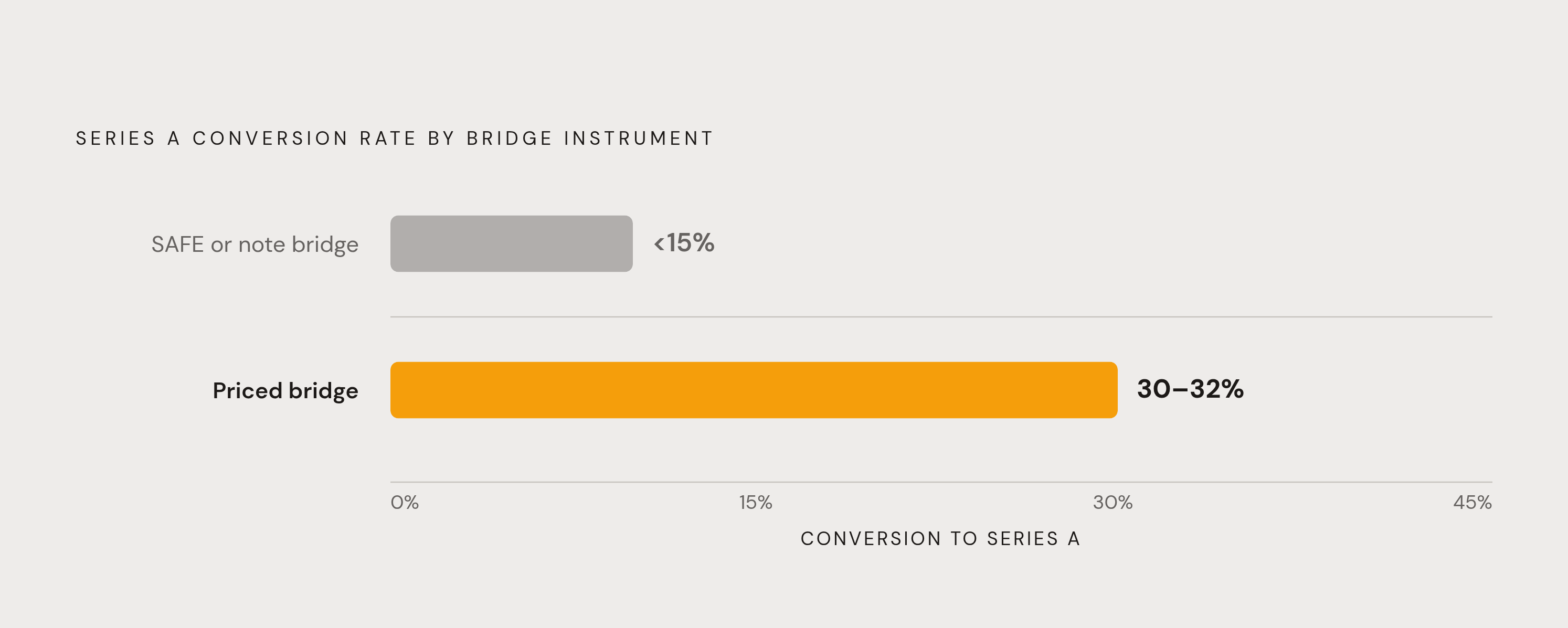
Bridge rounds have become more common as that gap widens, and they carry a cost beyond the dilution itself. Bridge rounds now make up a meaningful share of all cash raised at the Series A stage, but the instrument used for the bridge sends a signal that investors read closely. Founders who bridge with a SAFE or a note after a priced seed round see a dramatically lower Series A conversion rate than founders who bridge with a priced instrument, and founders who bridge with a priced instrument see a conversion rate in the range of 30 to 32 percent. The instrument choice itself tells Series A investors whether existing insiders have real conviction in the company or are simply buying time before a harder conversation.
Part of why the bar has hardened is structural rather than reflective of any individual founder's execution. The ratio of seed deals to Series A deals has expanded significantly since 2008, so the number of seed-funded companies competing for the next round has grown far faster than the number of Series A investors able to fund them. Runway length and the traction bar are the two variables a founder actually controls heading into that conversation, and both have to be planned against the current reality, not the one that existed three or four years ago.
Sector-by-Sector Benchmarks for a Realistic Comp Set
The useful benchmark for any individual founder is the sector-specific range for their category and stage, not the blended market median, and those ranges diverge widely enough that using the wrong one will mean mispricing the round in a direction a sharp investor will catch immediately.
Healthcare and biotech companies see round sizes and post-money valuations comparable to AI and ML, a function of the capital intensity these companies require long before commercial revenue. Consumer app companies, by contrast, see round sizes and post-money valuations at the lower end of the seed market, reflecting the different capital needs and risk profile of that category. If you're building in either of these categories, find your own sector's range before you open a single investor conversation, rather than starting from the blended figure that neither describes.
Instrument choice tracks round size as well. SAFEs dominate smaller raises, and post-money, cap-only SAFEs are now the default structure for that segment, but priced equity becomes the dominant instrument once round sizes grow larger. That means the right instrument for a given company depends partly on where in its sector's range the round actually falls. For founders still pre-product or pre-revenue raising on a pre-seed SAFE specifically, valuation caps scale with raise size: smaller raises anchor at lower caps, while raises in the low millions anchor higher, giving founders a reference point even before they have metrics to show.
Running a structured raise that converts benchmarks into a closed round
Knowing the right comp set is necessary, but it doesn't close a round by itself. Founders who close on favorable terms run a structured, high-velocity process, and that process compresses the fundraising timeline and creates the competitive dynamics that actually produce term sheets. The seed fundraising funnel is long and the conversion rate at each stage is low: founders typically contact a large number of investors to close a single round, and only a small fraction of those conversations progress from a first meeting to a closed check. That funnel has to be managed as a pipeline with explicit stages, not as a loose series of one-off conversations that each get re-pitched from scratch.
Meeting preparation closes much of the gap between a strong pitch and a signed term sheet. AI-driven call intelligence tools that analyze post-meeting performance, flag recurring objection patterns, and surface specific areas to tighten before the next conversation are now in active use by founders running competitive processes, and that kind of iteration compounds across dozens of investor meetings in a way a single well-rehearsed pitch cannot replicate.
The valuation conversation itself goes more smoothly when the founder has the benchmark fluency this piece has walked through. A founder who can explain precisely why their post-money cap reflects their sector's comp set, rather than the AI headline figure that doesn't apply to them, signals operational discipline to an investor evaluating the deal. That fluency reduces the friction that comes from either an overpriced ask that invites pushback or an underpriced one that leaves value on the table.
The decisions founders face right now: runway length, valuation anchor, and instrument choice
Three decisions made at seed close compound across the following 24 to 30 months and shape whether a founder arrives at Series A from a position of strength or one of desperation: how much runway to buy, what valuation to accept, and which instrument to close with.
Runway length should target 18 to 24 months of real operating room, sized to reach a defensible traction milestone rather than sized to minimize the round's dollar amount. The valuation anchor should come from the sector-specific comp set established above, stress-tested against the step-up math covered earlier: a founder setting their seed post-money should be able to show that hitting their sector's Series A traction bar within the runway window produces a step-up ratio that a Series A investor will actually find investable. Instrument choice follows round size. For smaller rounds, a post-money SAFE with a cap and no discount is now the market default. Above a certain size threshold, priced equity increasingly takes over. The risk to model carefully in either case is SAFE stacking: founders holding multiple instruments that will convert simultaneously at Series A need to run the full combined dilution calculation before closing any new instrument, not after the fact.
The objection that a lower dilution percentage at seed is always the safer choice deserves a direct answer. Raising less than the business needs in order to protect a dilution number isn't conservative. It raises the probability of a bridge round, and a bridge round carries both a dilution cost and a signal cost that further reduces the odds of a successful Series A conversion.
The founders who close Series A rounds on strong terms are rarely the ones who set the highest seed valuation or gave up the least equity at close. They're the ones who raised enough capital to reach a defensible traction milestone, who targeted investors whose thesis and check size actually matched their deal, and who ran a process disciplined enough to generate real competitive pressure among term sheets. Understanding which of the two seed markets a company actually belongs to, and pricing accordingly, is what separates that founder from the one still running benchmark math after the round has already closed badly.