Venture Debt vs Equity for Early-Stage Startups
Venture debt can preserve ownership when a company can support repayment.

Venture debt versus equity is a decision about a startup’s capacity to carry obligations. Equity funds uncertainty, while debt can preserve ownership when it finances a credible path to the next milestone. Metal’s investor and pipeline intelligence can help with the raise process, but the financing choice depends on whether the company can repay, when it will reach its milestone, and the full cost of each instrument.
Why early-stage founders are rethinking the equity-only default in 2026
The same capital target now means surrendering more ownership, while the path to Series A has stretched. Valuations under pressure in 2026 make dilution more expensive per dollar raised than in the boom years. Stifel Venture Banking frames venture debt as a way to balance the increasing cost of equity, supplement rounds, and approach the next raise from a stronger position.
Venture debt has remained a resilient capital source in the slower venture environment, even as transaction counts have moderated. Average loan sizes have grown as lenders write larger checks because they have more confidence in later-stage and AI-backed borrowers. For an early-stage founder, the relevant question is whether the company’s revenue, investor backing, and timing support borrowing.
How venture debt actually works and what distinguishes it from a traditional loan
Venture debt is underwritten against the strength of a startup’s equity investors and growth trajectory, without relying on profitability or hard collateral. That distinction makes it accessible to pre-profit companies that would not qualify for a traditional bank loan. Loan size is typically tied to the most recent equity round. Repayment usually begins with an interest-only period before principal payments start, aligning the repayment schedule with expected growth and runway. Stifel Venture Banking describes common features including long draw periods, no mandatory draw requirements, limited fees, competitive interest rates, and minimal or no financial covenants.
Warrant coverage is a percentage of the loan amount. Venture debt warrants are almost always exercised on a cashless basis at a liquidation event without the lender paying cash out of pocket. Covenants create a different exposure, because a breach can trigger default, renegotiation, or conditions that complicate the next round. Founders should read every financial covenant, MAC clause, and prepayment penalty against a scenario in which the company is slightly off-plan, rather than treating the interest rate as the complete price.
How equity financing works and what it provides that debt structurally cannot
Equity provides permanent, non-repayable capital, with investors absorbing the loss on their investment if the startup fails. Sharing the risk this way is key when a company cannot predict or meet its debt obligations. Before a company has revenue or product-market fit, it needs capital that can cover uncertain outcomes without a deadline for repayment. This distinction matters especially in biotech, deep tech, and hardware, where development takes a long time. When revenue is too far off to cover debt service, equity is the workable choice.
Equity also brings expertise, networks, board-level guidance, and the signal of an institutional backer. Those contributions can matter for recruiting, partnerships, and future fundraising, so the comparison cannot reduce equity to dilution alone. In return, investors negotiate rights including protective provisions, board seats, liquidation preferences, pro-rata rights, and anti-dilution protections. These terms affect how much control founders have and how they can raise funds later, even though they come with no monthly cash payments.
The specific conditions where venture debt outperforms another equity round
Venture debt earns its place when a company has reduced enough uncertainty to support repayment and has a defined, near-term use for the money. The strongest case is a bridge between equity rounds that funds a milestone capable of improving the next valuation. A company that has recently closed a Series A may need additional runway to reach a specific ARR threshold, secure an enterprise contract, or complete a clinical trial. Debt can fund that interval without requiring a new valuation event. If the milestone improves the next-round valuation, the company can then raise equity while giving up less ownership per dollar.
Borrowing is most useful when the additional runway changes what the next investor can underwrite, rather than merely postponing the same financing problem. Stifel Venture Banking identifies the period immediately after a Series A, B, or C close as the best time to secure venture debt. Fresh capital and recent traction give founders more leverage and lenders more room to accommodate structure. Founders who track investor interest and forecast their next institutional round can assess that bridge more precisely than those relying on an untested fundraising timetable.
The specific conditions where equity is the correct and only viable instrument
Pre-revenue and pre-product-market-fit companies usually lack what they need to qualify for venture debt. Without MRR, demonstrated payment capacity, or a credible near-term liquidity event, there is little financial evidence to support repayment. The absence of institutional backing also removes a central part of the lender’s underwriting basis. Stifel Venture Banking describes venture debt as a strong fit for companies that have recently closed an institutional round, typically at Series A and beyond. Debt being unavailable is therefore useful information about the company’s current position.
Even with backing, uncertain cash flows can make equity the more appropriate risk structure. Project revenue, seasonality, long manufacturing cycles, and reliance on a single major customer can put repayment at risk or lead to restrictive covenants. A debt deadline does not move simply because revenue arrives late, and that pressure can force a fire-sale or a down round. A company still searching for product-market fit may also need an investor’s expertise and introductions more than it needs another source of cash. The practical test is whether the company can articulate a credible path to servicing or refinancing the loan through revenue or a follow-on raise within its term.
How the hybrid structure — a smaller equity round plus venture debt — changes the dilution math
For a post-traction company, the most ownership-efficient structure is often a combination of equity and venture debt. The total capital target stays constant while the amount raised as equity falls. If a debt tranche fills the difference, fewer dollars are exchanged for permanent ownership at the current valuation. Interest and warrants replace part of that ownership cost, although they also introduce repayment and contractual obligations. The founder retains more ownership only if those obligations remain supportable.
Ownership not sold now remains part of the founder’s stake through later rounds and contributes to proceeds at a successful exit. A smaller equity ask may also give founders more room to negotiate because debt covers part of the money they need to raise. That advantage depends on the equity round being closeable on institutional terms, since the lender underwrites the sponsor and the round behind the borrower.
Sizing is therefore a starting discipline. The debt tranche should be a meaningful fraction of the equity round while remaining smaller than the round itself. Beyond a supportable size, debt service and covenant exposure can consume the value of the dilution savings. The hybrid succeeds when it reaches the same operating objective with less ownership sold, without constraining the company if performance falls short.
What the research on venture debt's ecosystem effects tells founders about when and where it works
David Dekker, Vanessa Galeano-Duque, and Dimitris Christopoulos’s June 2026 study in the International Review of Economics and Finance places this bridge logic in a broader context. Their research across countries links greater access to venture debt with less early-stage equity funding but more late-stage equity investment. The aggregate effect on capital available to startups is positive. The authors interpret this as a reallocation that improves ecosystem effectiveness and efficiency by helping startups progress toward later stages.
That finding addresses the crowding-out argument without dismissing it. The authors still call for policy attention in emerging markets, where early-stage funding is scarce and losing some of that capital is a concern. For founders, the distinction is important because an ecosystem-wide benefit does not establish that every borrower should use debt. The research supports funding progress from one milestone to the next without repeated valuation events, while keeping equity where companies still need risk-bearing capital.
How to run the debt-vs-equity decision as part of a structured raise process
Founders should first close an equity round, or reach late-stage negotiations, and then evaluate debt as a supplement. The debt tranche needs an exact use of proceeds, whether that is runway to a named milestone, capex, or a bridge to profitability. Founders should check MRR, growth rate, how large the debt is compared with the equity round, and which covenant breaches could occur under a pessimistic scenario. Approaching lenders because equity is stalling reverses the sequence and exposes the weakness they will price.
Founders should find investors whose stage and sector interests fit the company, build a structured pipeline, and keep to a regular outreach cadence. Metal provides AI-powered investor matching against fund mandates, check sizes, and sector focus, together with pipeline management, automated outreach cadence, and meeting intelligence. For the equity portion of a hybrid raise, that infrastructure supports the relationships and preparation on which lender confidence also depends. It does not replace the need for a closeable institutional round.
Once equity closes, timing becomes operationally important. Lenders presented with fresh institutional backing, a named lead, and strong metrics can move from term sheet to close in a few weeks. Founders who wait until runway is tight give up the leverage that helps them get flexible terms. Reporting infrastructure should also be in place before it is needed, because lenders have information rights and financial covenants while equity investors expect milestone updates. The raise is not complete as an operating responsibility when the funds arrive.
A practical decision framework for Seed and Series A founders choosing between the two instruments
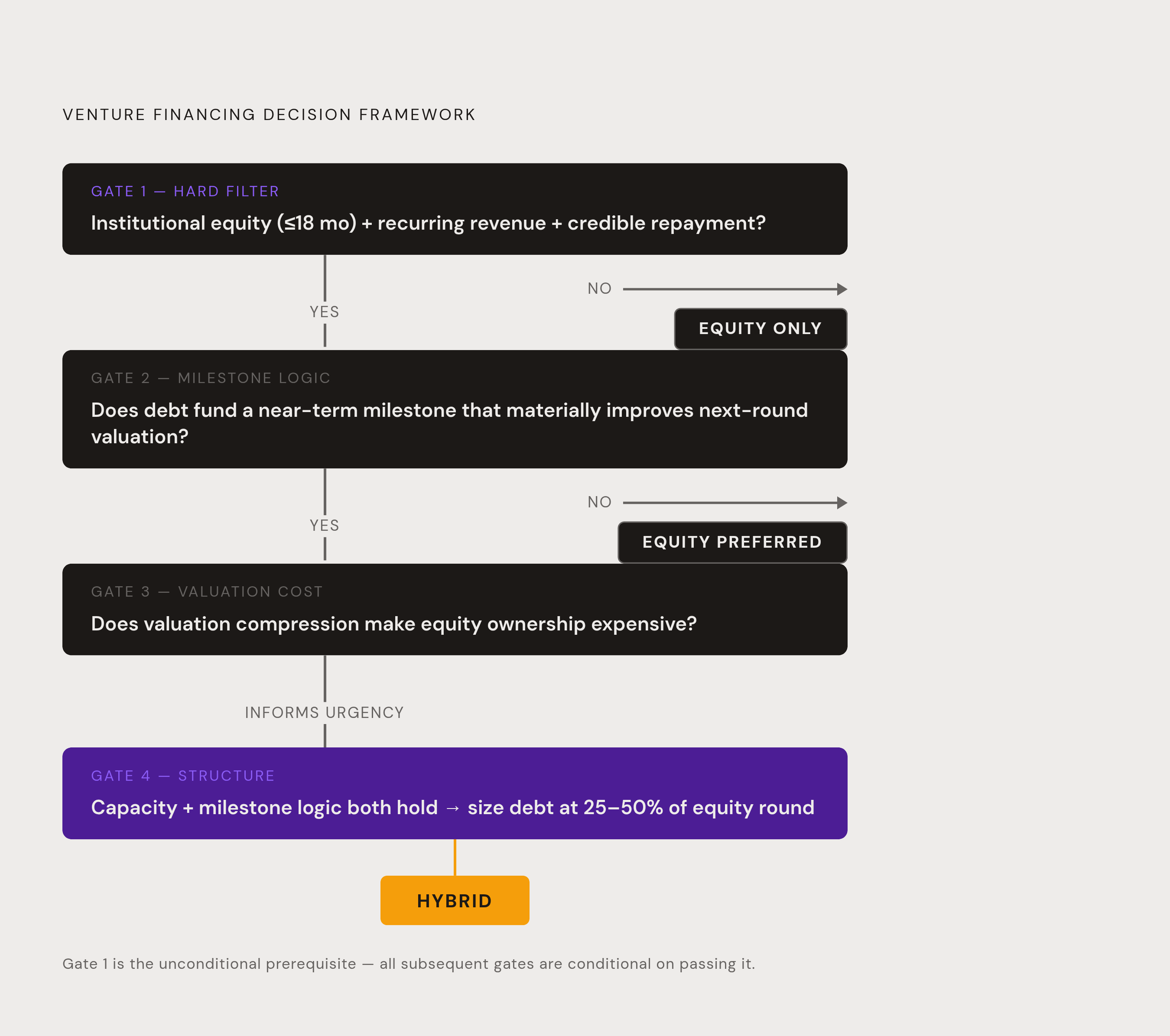
The company should have institutional equity backing from the past 18 months, predictable recurring revenue, and a credible path to repayment or refinancing within the loan term. If any of those conditions is missing, equity is the correct instrument under this framework. Difficulty raising equity may identify the uncertainty that still requires equity to absorb it.
Next, establish whether the debt funds a specific, near-term milestone that would materially improve the next-round valuation. The case for debt is weaker when it pays for general operating expenditure without a near-term catalyst. Then assess the equity market, since valuation compression raises the ownership cost of equity while a strong available valuation reduces the urgency of substituting debt. Market conditions inform the choice only after repayment capacity has passed the test.
If both capacity and milestone logic hold, assess a hybrid with debt at 25–50% of the equity round as a starting sizing discipline. The structure must remain workable under a pessimistic scenario, including its payment schedule and covenants. When choosing a lender, also check whether it understands how the venture ecosystem works, can support the company through its full lifecycle, and offers value beyond the loan itself. An acceptable interest rate cannot compensate for an unsound repayment path or misunderstood contractual exposure. The final decision is situational, and rigor about the company’s position beats ideology about the instrument.