Investor Pipeline Stages That Actually Reflect How a Raise Unfolds
Stage-by-stage investor pipeline design that tracks conviction instead of contact activity.
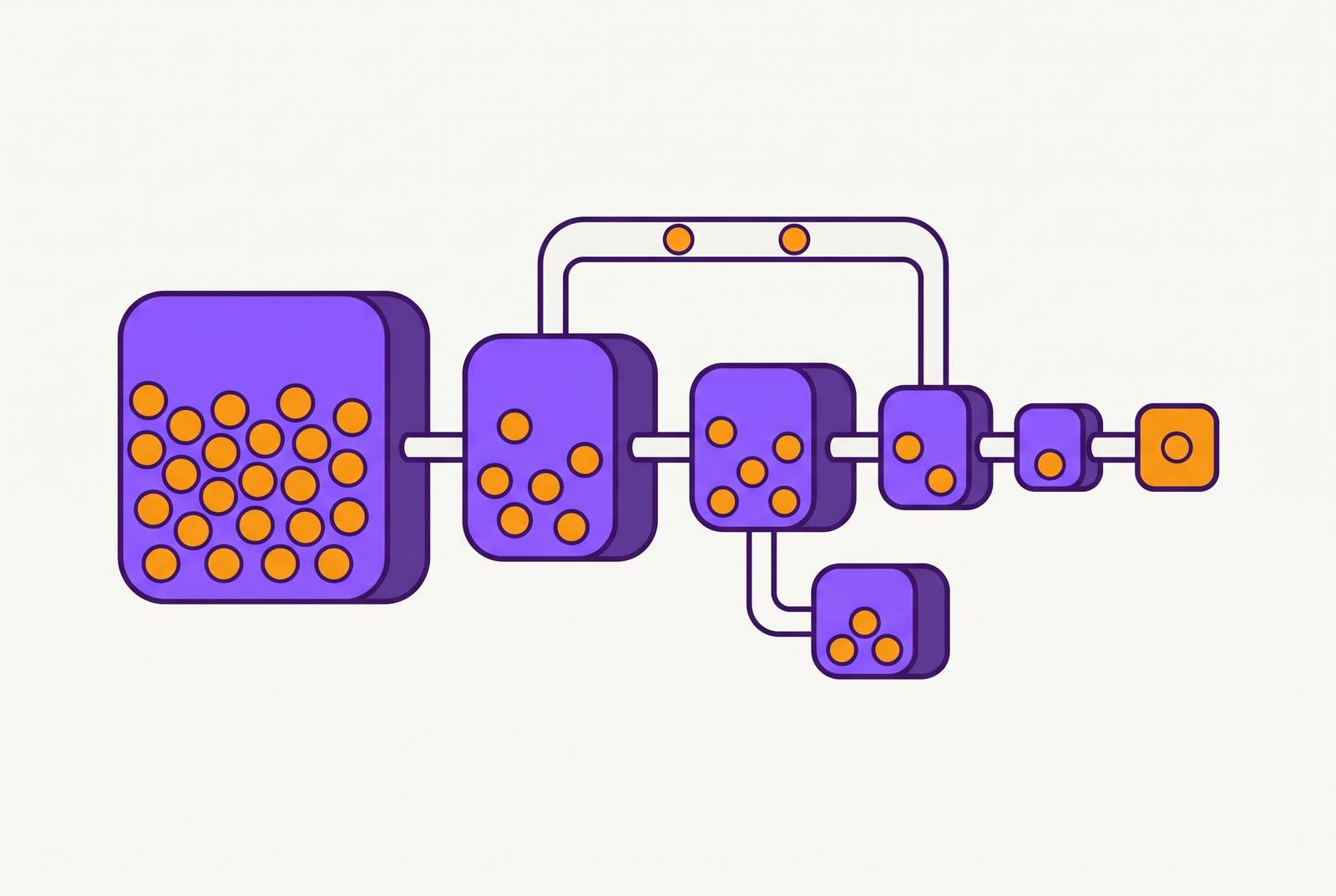
An investor pipeline should track how an investor reaches conviction. The useful stages are Research, Signal, Engagement, Conviction-building, and Close. Each describes a different decision state, with a distinct failure mode and a corresponding action.
Why sales CRM stages fail founders as a pipeline model
Consider a borrowed CRM stage list that goes from Contacted through Meeting Booked, Pitch Sent, a stage for more messages, and Closed. What is it actually measuring? Until the final entry, it largely records contact between the founder and investor. A meeting was arranged, a document was sent, or another message went out. None of those events, by itself, establishes whether the investor is closer to making an investment.
The mismatch begins with the decision being tracked. Sales CRMs track a buyer as they move toward a purchase, while fundraising tracks an investor as they move toward conviction. Partnership meetings, fund deployment cycles, and work with co-investors shape that process in ways the founder cannot see. The founder does not control the internal clock.
In a sales funnel, a quiet prospect is usually treated as lost, but an investor who goes quiet after a first meeting may be checking references or waiting for portfolio approval. Labeling that investor “cold” confuses the absence of visible contact with the absence of work. The reverse mistake costs just as much, when a warm conversation is logged as progress even though there is no sign that work inside the fund has moved forward.
How investor decisions actually unfold, stage by stage
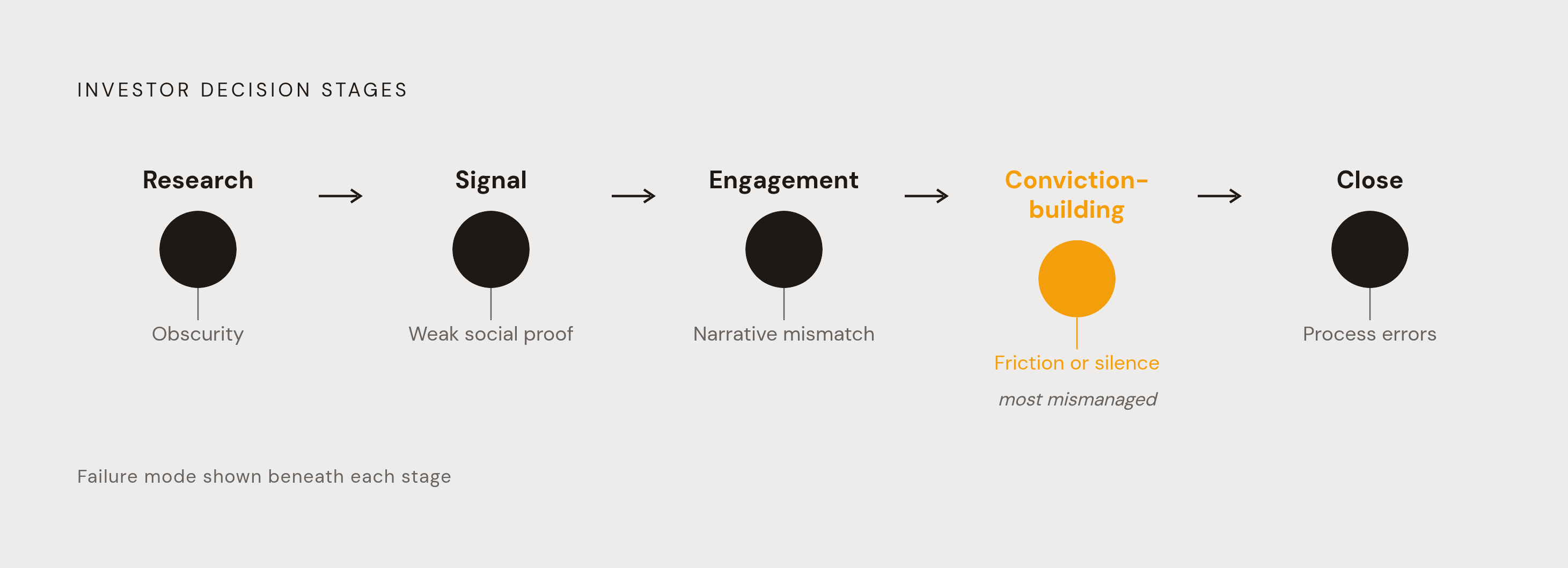
Research begins when the investor has seen the company name but formed no view. Signal marks the registration of a positive data point, such as a warm introduction, a mention from a respected founder, a deck open, or a reply. The investor now has a reason to pay more attention. No meeting has happened, and the strength of that reason still varies.
Engagement begins with the first meeting and includes follow-on meetings while the investor tests the narrative and forms a hypothesis. This is the most visible part of the process, which helps explain why founders give it disproportionate weight. Conviction-building starts when the investor likes the company and undertakes the work required to reach yes. Most of the work now happens inside the fund. Reference calls, data room review, partner meeting preparation, and co-investor conversations belong here, even when they produce little visible contact with the founder.
Close follows the investment decision and includes term sheet negotiation, diligence, and the wire. The process becomes administrative, with process errors and competing priorities as its failure modes, while Conviction-building can be derailed by friction or silence. Earlier stages have their own vulnerabilities, with narrative mismatch in Engagement, weak or absent social proof in Signal, and obscurity in Research.
What belongs in a pipeline before the first meeting is booked
The practical implication is to begin with a deliberately narrow, criteria-filtered investor list. Whether a name belongs in it depends on thesis alignment, check size, whether the fund is actively deploying, and fund timing. Adding more names will not make up for a poorly qualified list. Adjacent portfolio companies show that there may be a thesis fit, and the amount the investor typically invests must fit the round size. Fund vintage and deployment cycle also constrain the opportunity, since a fund in year six of a ten-year cycle is unlikely to lead a new deal.
At Research, the pipeline entry should therefore represent a qualified lead. An investor should not move to Signal until fit has been confirmed on at least two criteria and a positive signal exists. Qualification and interest are not the same thing. A fund can fit the company without having registered any interest, just as a reply can arrive from a fund whose check size does not fit the round. Keeping those distinctions visible prevents outreach activity from inflating the apparent opportunity.
To create Signal, founders should make the introduction easy for the connector by drafting an email that needs only a brief personal note before forwarding. Where no warm introduction is available, cold outreach should use a one-line hook, two-line traction proof, one-line ask, and a deck link. Its goal is a reply. The pipeline should then record who made the introduction, what prompted the outreach, and what the investor said in response. That provenance helps explain how quickly a contact may move through Engagement.
How to manage the Engagement stage without misreading where a deal stands
Once meetings begin, the central distinction is between an investor’s tone and their internal state. An investor may be exploring, genuinely interested, or politely exiting while sounding positive in each case. The useful evidence is a concrete next step, especially one that reveals how the investor intends to test the opportunity. More meetings alone do not establish a stronger investment case.
The founder’s task is to reduce ambiguity before the conversation ends. A clear next step, a named timeline, and a specific ask provide a firmer basis for classification than a general expression of interest. When an investor asks for data room access, a reference name, or a partner introduction, it shows what work they plan to do. The timeline should belong to that agreed work. It is not a universal deadline imposed on every investor regardless of the fund’s process.
The Engagement record should capture the date, format, investor-side attendees, qualitative sentiment, and specific next step agreed. It should also preserve evidence of internal movement, such as a partner being copied into correspondence or a portfolio company reference being requested. This separates processing from stalling without pretending the founder can see everything. A quiet investor with evidence of internal movement is different from an enthusiastic investor with no next step. Positive sentiment without that next step is a soft pass.
The Conviction-building stage and why it is the most mismanaged phase
As the investment becomes more plausible, the decisive work becomes less visible. Inside the fund, the deal may be presented to the partnership, a thesis memo written or updated, references called on the founder and team, and a co-investor sought. A relationship with someone inside the firm may reveal parts of this work. Without that visibility, the founder has less information precisely when the outcome feels closer.
The operational response is to reduce friction. An incomplete or disorganized data room obstructs review, while unbriefed references may give flat answers that do little to support the case. These are things the founder can address directly. Briefing references and keeping the data room complete and in order help the investor do the work without putting pressure on them. Aggressive follow-up, by contrast, can signal anxiety.
Silence at this stage needs to be interpreted in context. When a previously communicative investor goes quiet for a notable stretch after accessing the data room, a thesis objection raised in the partnership meeting or an uncommitted co-investor may be the cause. Neither explanation is established by silence alone. The appropriate action is a direct, non-anxious check-in asking whether there is anything else to provide. That leaves room for the investor to identify an obstacle without requiring the founder to invent a diagnosis.
Competitive pressure also belongs here, rather than in early Engagement. Investors can see through attempts to create urgency before they reach Conviction-building, while having several firms do conviction work at the same time creates real competition. The founder prepares for this before outreach, well ahead of negotiation. Batching meetings across firms into a two-to-three week window is the structural tool for bringing those processes into alignment.
How stage timing and round benchmarks should inform pipeline construction
How long a stage takes depends partly on whether the company meets the proof thresholds that investors use for the round. Those thresholds have moved materially since 2021. At Seed, the ARR floor an investor needs at close can explain why a founder keeps reaching Engagement without moving into Conviction-building. Talks may go on even when there is still no evidence to back an investment thesis. In that situation, elapsed time is not a reliable measure of proximity to a decision.
At Series A, valuation expectations can create a different obstruction. Founders who benchmark their round against AI-driven headline valuations risk a divergence in term sheet expectations during Conviction-building. This disagreement comes up after the investor has already shown interest. It is therefore possible for a pipeline to contain genuinely interested investors while still overstating the likelihood of an executable deal. Benchmarks should calibrate the assumptions behind those entries.
A well-executed Series A raise takes roughly 8–14 weeks from first meeting to term sheet when metrics are clean. Pipeline stages should be planned backward from that target. That window is conditional. Time spent in Engagement or Conviction-building varies by investor, and the window ends at the term sheet. Close still needs time of its own for negotiation, diligence, and finishing the paperwork.
What a working pipeline actually looks like week to week during an active raise
During an active raise, the pipeline should be reviewed weekly as a live instrument. The review starts with the investor’s actual stage. What is the specific next step, and who owns it? What evidence of internal movement has appeared since the last touchpoint, what friction can be removed, and should the deal be reclassified?
To answer those questions, the founder needs a single source of truth with every investor’s stage, last touchpoint, next step, and sentiment. If those details are scattered, the weekly discussion becomes an exercise in reconstructing events. In a working review, a meeting is interpreted through its agreed next step, and silence is interpreted through the evidence of internal work.
Reclassification keeps inactivity from disappearing inside an optimistic stage label. An investor who takes no concrete next step within a short window after the last positive touchpoint moves to a holding category. An investor with zero data room engagement after thirty days should receive a final nudge or move to Passed, while remaining in the database for the next round. These rules distinguish active work from unresolved hope without discarding the relationship.
Existing investors remain a structural asset throughout this process. Their introductions can move contacts from Research to Signal faster than cold outreach, and they can speak to prospective investors during Conviction-building. Their participation in the round also signals confidence. The weekly review should account for these contributions within the relevant deal, so that an introduction or reference conversation is understood as part of its progression.
The hardest part, however, is applying the framework honestly. A founder who is emotionally invested in a particular firm will tend to overweight encouraging signals and discount evidence of a stall. No stage definition can remove that temptation. The weekly review works only when the founder is willing to move a deal out of the active pipeline despite wanting it to remain there.