AI Tools for Pitch Deck Creation and Iteration
AI can build a deck fast, but investors spot the ones that prove it.

The pitch deck has become easier to make and harder to win with in the same year. What used to take a founder a week of late nights in PowerPoint now takes under a minute of prompting, and that compression has moved the entire problem somewhere else: not whether a founder can produce something that looks like a deck, but whether anything in it can survive contact with an investor who has seen a thousand nearly identical ones this quarter.
Tools in wide use now generate complete, investor-convention-compliant slide structures from a single line of text in under 60 seconds. The format problem that used to eat a founder's weekend is largely solved. But investors have not stood still while this happened. They have built their own AI layer on the receiving end: software that pulls metrics out of PDFs, checks the numbers against each other for inconsistencies, flags growth curves that look too clean to be real, and routes decks to the right partner based on keyword signals in the text. The same automation that lets a founder produce a deck in a minute is the automation an investor uses to spot that it was produced in a minute.
Founders now face a two-sided problem. AI has filled investor inboxes with decks that share the same structure, the same slide order, and often the same cadence of language. The bar has shifted onto exactly the things AI cannot generate on a founder's behalf: real traction numbers, a voice that sounds like an actual person built the company, and financial logic that holds up when someone pulls on it. Everything that follows in this piece is about how to use the speed AI offers without handing over the one thing that speed cannot buy, which is proof.
What the current tool landscape does, and for whom
The tools on the market in 2026 split cleanly by what they automate, and picking the right one depends on which stage of deck-building is actually slowing a founder down.
Gamma generates full decks from a single prompt and produces a complete structure in under 60 seconds. Its card-based layout reads well when shared as a link, though its PowerPoint export is a known weak point: layouts break and fonts don't match once a deck leaves Gamma's own environment. It has a free tier and paid plans above it, and it suits pre-seed founders who need a working first draft fast to share by link.
Beautiful.ai takes a different approach. Its Smart Slides auto-align, resize, and reposition content as it's edited, so formatting stays consistent without a founder touching a ruler or guide. Users report real time saved compared to building in PowerPoint by hand, though the tradeoff is less control over pixel-level design choices. There's no free plan, only a trial, with paid Pro and Team tiers and an Enterprise option above those. It fits best where brand consistency matters more than raw speed, serving corporate presentations better than scrappy first pitches.
Pitch is built for teams working on a deck together, with real-time co-editing, co-presenting, and engagement tracking through what it calls Pitch Rooms. Its free plan includes unlimited presentations, with paid tiers for more advanced use. It's a stronger fit for agencies and collaborative deal-room work than for a solo founder's fundraising process.
Decktopus walks a founder through creation by asking questions first, generating the deck step by step as answers come in, a useful structure for founders who don't yet know what belongs on each slide. Storydoc builds scroll-based, interactive presentations with CRM-driven personalization, and it leans more toward sales proposals than investor pitches specifically. Prezent AI, built around an engine it calls Astrid AI, builds brand-aligned decks from prompts, notes, or documents a founder already has, and adds a library of communication best practices along with access to human designers, aimed more at enterprise teams refining an internal pitch process than at a founder racing toward a term sheet. It runs on custom pricing with a free trial.
None of these tools compete on the same axis. Some tools solve the blank page, some solve formatting, and some solve getting a team aligned on one deck at once. Understanding which problem each one solves matters more than picking the single "best" one, because none of them solve the harder problem: making the deck's underlying evidence true.
What AI handles well
AI tools have gotten very good at a narrow but real set of tasks, and founders should use them for exactly those tasks and not much more.
They enforce the structure investors expect: problem, solution, market, business model, traction, team, and ask, in that order, so a founder doesn't accidentally bury the ask on slide four or forget a team slide. They clean up the visual noise that used to eat hours of a non-designer founder's time, fixing alignment, spacing, and font consistency automatically. They turn a blank screen into a working first draft in minutes, giving a founder something to edit. And once real content exists, they're fast at reformatting, reordering, and tightening copy at the founder's direction.
Past that point, the tools run into a wall they cannot get around, because the wall is made of information they don't have access to.
The traction slide is the clearest example. An AI model has no access to a founder's actual revenue, actual user counts, or actual retention numbers, so anything it generates there is invented by definition. Investors have learned to spot the signature of invented traction almost on sight: growth curves that are too smooth, percentages that round too perfectly, numbers that never seem to have a bad month. A placeholder traction slide doesn't buy a founder time anymore. It gets noticed immediately.
Financial logic breaks the same way. Left to its own devices, AI tends to produce suspiciously round figures and margins that improve over time with no stated reason why. Investors now actively scan decks for exactly this pattern: a cost structure that improves with no stated driver, a growth curve with nothing underneath it, a page of jargon with no real substance to back it up. Practitioners have a name for this now: AI fingerprints. It's a signature as recognizable to a trained eye as a copy-pasted paragraph is to a teacher, marking slides where the model filled gaps with whatever sounded plausible.
Founder voice carries the same risk in a subtler form. AI-written narrative is competent and readable, but it reads like AI wrote it, flattened into the same tone a thousand other prompts produce. The real danger compounds from there: investors increasingly run their own AI tools over incoming decks to summarize them before a human ever reads the thing. A deck written entirely by AI, summarized by another AI on the receiving end, produces a summary of a summary, two layers removed from any actual person. Whatever specificity or conviction might have persuaded a partner to take a meeting gets filtered out twice before anyone human sees it.
Execution ability gets tested in person, not on a slide. Whether a founder can take hard pushback, change course when the data says to, or work well with a board gets tested in a room, not on a page. But the deck is still the document that earns a founder that room in the first place, and a generic deck never gets that far.
A four-stage workflow for using AI without losing the argument
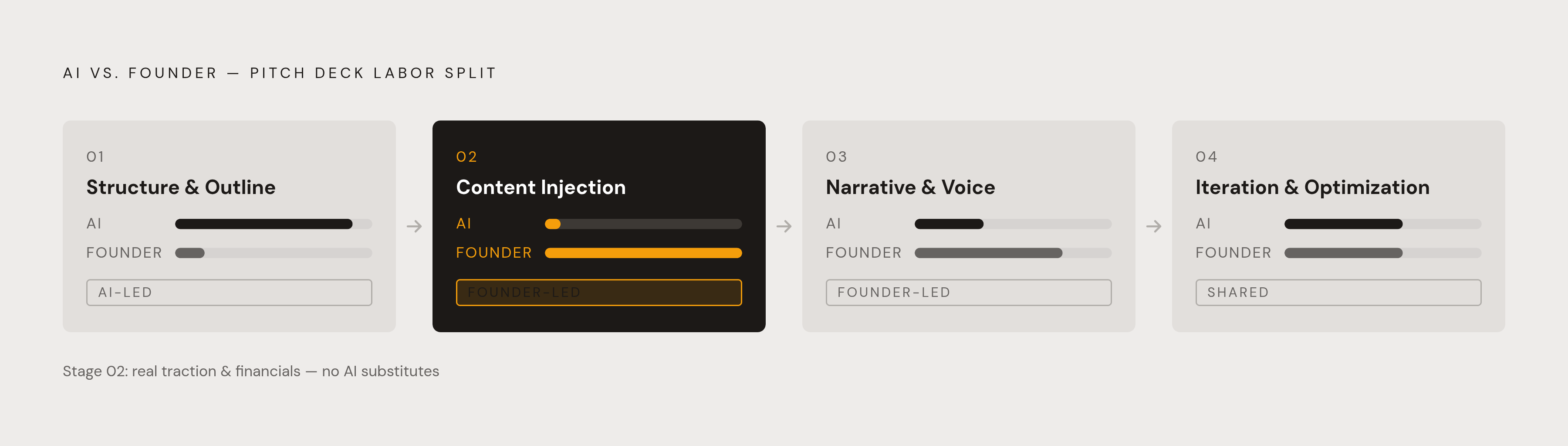
AI works best in deck creation as a drafting and formatting layer the founder then overrides with real content, not as the source of the content itself. The following four stages describe how that division of labor should play out in practice.
In the structure and outline stage, let AI lead. A deck generator's job is to produce the initial slide order, problem through ask, and tools like Slidebean and Gamma have that investor-convention sequence well encoded, which saves founders from structural mistakes that can sink a deck before anyone reads a word of it. The output at this stage should be treated as a checklist used to confirm that nothing is missing before the founder's own content replaces it.
Content injection is where the founder takes over and AI shifts to an assisting role. The traction slide deserves a full stop in any discussion about this stage, because it's the one slide where AI involvement should be close to zero. Build it manually, in a spreadsheet, with every number checked by hand before it ever gets imported into a chart. This is the slide where ownership has to be total. Financial model slides follow the same logic: input actual unit economics, actual burn rate, actual ARR, and use AI only to format and label those numbers, never to generate them, then check by hand that every figure is internally consistent with every other one on the page. Market sizing carries its own specific risk. A TAM/SAM/SOM slide built on AI-generated market figures is a known red flag to investors who now run their own AI checks against those same claims and catch the gaps fast, so every figure needs a named, citable source with that sourcing visible on the slide itself. The team slide deserves more attention than it used to get, because AI has made every other slide easier to produce. That leaves the team slide as one of the few places a deck can still show something a competitor's deck can't fake. It needs to be entirely human-written, built around a specific argument for why this team, specifically, can execute this problem, not a set of generic bios.
Narrative and voice is a founder-led stage too. AI's role here is to tighten and shorten copy after the founder has written the actual argument, not to generate that argument from a prompt. The problem and solution slides are where a founder's specific voice matters most: the strongest decks open on a concrete, first-hand account of the problem rather than the generic market framing an AI model defaults to when given a blank slide. Speaker notes are one place AI genuinely earns its keep at this stage, drafting a first pass at talking points that a founder then rewrites to match how they actually talk in a room.
Iteration and optimization is where founder and AI work side by side. Deck analytics, available in tools like Slidebean, Beautiful.ai, and Pitch, show which slides investors spend the least time on, and that's a signal the argument isn't landing on that page, not just that the layout needs another pass. Founders should resist the natural pull toward more design polish at this stage, since that's the thing these tools are best at and most eager to offer, and instead spend the time sharpening the argument on whichever slide is underperforming. One last check closes the loop: a general-purpose AI assistant like ChatGPT or Claude can serve as a pressure test, asked to summarize the deck and name what's missing or unclear. If a model can't pull a coherent investment thesis out of the deck, a human investor running a similar screening tool on the other end may route the deck out before a partner ever opens it.
Three shifts in what the bar requires in 2026
Investors have raised their expectations in three specific, identifiable ways this year, and a deck that doesn't address all three gets screened out before a first meeting gets scheduled, no matter how clean the slides look.
The first shift concerns hallucination governance, now its own diligence category. AI hallucination incidents are now documented extensively in U.S. courts, and EU AI Act obligations are rolling out through 2026 and 2027, which together have made investors specifically ask founders building AI products to walk through how their system catches and contains its own errors. A founder who deflects that question in a diligence call gets rejected on the spot. A founder who has actually built verification steps, logging, and human review into the product turns the same question into an argument for why the company is harder to copy. The deck needs to address this on the product slide (or a dedicated architecture slide for AI-native companies) before an investor has to ask.
The second shift is the collapse of the AI wrapper narrative. Investors are now explicit about telling apart a company where AI creates a real, defensible edge from a company that put a nicer interface on top of someone else's foundation model. A deck needs to show the specific thing that makes the AI hard to copy, a data advantage that compounds over time, a cost structure a competitor can't match, a workflow integration too deep to rip out, not just a claim that the product "uses AI." This is exactly the gap AI-generated decks fall into by default, since a model has no access to a company's actual defensibility and will produce a vague capability claim in its place every time.
The third shift moves the bar from growth narrative to revenue evidence. What gets funded in 2026 is a small team with real revenue and tight customer evidence behind it: customers who renew without being chased, low churn, high engagement. Decks that lean on total addressable market size or a roster of hires from big tech are not what's closing rounds anymore, because that kind of evidence exists nowhere except in the company's own books, where no AI tool can reach.
Put together, these three shifts describe the same underlying demand: a deck has to prove something true about a specific company, built by specific people, with specific numbers behind it. AI can build the frame around that proof faster than any founder could by hand a few years ago. It cannot build the proof itself.